Sunday, 19 April 2015

Rise in wildfires may resurrect 

Chernobyl's radiation

Fallout from the world's worst nuclear accident just won't go away. Radioactive clouds may once again spread
over Europe, as rising fires release radiation locked up in the upper layers of soil in the dense forests near
Chernobyl in Ukraine and Belarus
Forest fires there have already been re-distributing that radioactivity over Europe. But the situation is set to
worsen with climate change, political instability – and a bizarre effect of radiation on dead leaves.
After a reactor at the Chernobyl nuclear plant exploded in 1986, people were evacuated from 4800 square
kilometres of the most heavily contaminated areas in Ukraine and neighbouring Belarus.
This "exclusion zone" became ahaven for wildlife and a dense boreal forest.
Nikolaos Evangeliou at the Norwegian Institute for Air Research and colleagues have analysed the impact of
forest fires in the region, and calculated their future frequency and intensity. To do so they fed satellite
images of real fires in 2002, 2008 and 2010, and measurements of radioactive caesium-137 deposited
on the area, to models of air movements and fires.
They estimate that of the 85 petabecquerels of radioactive caesium released by the Chernobyl accident,
between 2 and 8 PBq still lurk in the upper layer of soil in the exclusion zone. In another ecosystem this
might gradually fall with erosion or the removal of vegetation. But in these abandoned forests,
says Evangeliou, "trees pick up the radioactive ions, then dead leaves return it to the soil".

Radioactive smoke

The team calculates that the three fires released from 2 to 8 per cent of the caesium, some 0.5 PBq,
in smoke. This was distributed over eastern Europe, and detected as far south as Turkey and as far west
as Italy and Scandinavia.
"The simulation probably underestimates the potential risks," says Ian Fairlie, former head of the
UK government's radiation risk committee, who has studied the health impacts of Chernobyl.
That's because the estimate depends on the half-life the team assumed for Cs-137, he says,
and some investigators believe it is longer.
The team's calculated release would have given people in the nearby Ukrainian capital, Kiev, an average
dose of 10 microsieverts of radiation – 1 per cent of the permitted yearly dose. "This is very small," says
Tim Mousseau of the University of South Carolina at Columbia, a co-author of the study. "But these fires
serve as a warning of where these contaminants can go. Should there be a larger fire, quite a bit more
could end up on populated areas."
And the average dose isn't the problem. Some people will get much more, as fires dump radioactive
strontium, plutonium and americium as well as caesium unevenly, and as some foods concentrate these
heavy metals, for example caesium in mushrooms. "The internal dose from ingestion can be significant,"
says Mousseau. The resulting cancers might be hard to spot among many other less-exposed people.
"But they will be very significant for those who experience them."
Increased forest fires seem likely. The area is due to get drier, according to the Intergovernmental
Panel on Climate Change. The team found thatdroughts are already worsening forest fires in both area
and intensity, and those are predicted to worsen.
This may be down to a range of factors, including lack of management of the forests. Most forests are
managed by removing dead trees, clearing roads or cutting fire breaks but this isn't being done here.
Moreover, dead vegetation that fuels fires is accumulating at a rate that has doubled since 1986, the team says.

Insect killer?

This is partly because the radiation itself seems to inhibit the decay of leaf litter, perhaps because it kills
key insects or microorganisms. "We brought litter from an uncontaminated zone into a contaminated
area and found it decayed only half as fast," says Evangeliou.
The models predict peaks of forest fires between 2023 and 2036. By 2060, fires might continue, but much
of the radioactive fallout will have decayed away.
To cap it all, once a fire starts, local fire-fighters in Ukraine have seven times fewer crews and equipment per
1000 hectares than elsewhere in the country – a situation unlikely to improve given the ongoing conflict.
The UN Environment Programme is installing video surveillance for fires, but much of the forest is
inaccessible or slow to reach due to blocked roads. "It's like a jungle in there," says Evangeliou.
"This is clearly an important problem and one that applies also to Fukushima, where a significant amount
of forest land has been contaminated," says Keith Baverstock of the University of Eastern Finland in Kuopio,
formerly head of radiation protection at the World Health Organization's European office. "They have a very
valid point. The lack of management of forests, the apparently slower decay of vegetation exposed to
radiation, climate change leading to drought and the expansion of forested areas all contribute to increasing
the risk of forest fire and therefore further dispersal of long-lived radioactive nuclides."
The actual amount of radioactivity redistributed by the recent fires is about a tenth of what was deposited
on Europe in 1986, and its health effects are still a matter of debate among epidemiologists.
But long-lived emitters of radioactivity persist and accumulate, so any dose is bad news, says Mousseau.
"A growing body of information supports the idea that there is no threshold below which they have no effect."
Journal reference: Ecological Monographs, DOI: 10.1890/14-1227.1
Stop Hinkley takes the message to Brussels: ‘No Subsidies For New Nuclear Power Plants’
Report by Jo Smoldon
Stop Hinkley were invited to Brussels to take part in a demonstration on the 24th March.  It took place at the EU headquarters and our Euro MEP Molly Scott Cato joined the list of speakers who inspired us.  We were thrilled to be invited as it was important for us to be there and represent our Stop Hinkley campaign, which was central for the other participant's presentations.  Molly spoke of Stop Hinkley's long standing commitment to the anti-nuclear campaign in Somerset over 30 years and acknowledged our presence and perseverance.
The demo was outside the EU headquarters and our Euro MP Molly Scott Cato joined the list of speakers who inspired us. We were thrilled to be invited and to take part – it was important for us to be there and represent our Stop Hinkley campaign which was central for the other participant's presentations.
Many countries and anti-nuclear groups were represented including Austria , Holland , Belgium and Germany . It was affirming that all of these people were there for us too, different groups coming together in a united way, with common cause, across all our different languages. It gave great strength to us all.
An Austrian speaker's informative talk highlighted the 1957 Euratom treaty which the EU countries all signed in support of nuclear. Austria sees today that this needs to be updated and for nuclear power to be removed. One solution is for individual countries to pull out from the Euratom treaty, perhaps Luxembourg and Austria , and then encourage Germany to pull out. Hopefully others will follow to undermine the dictating Euratom treaty.
Peter Smith, a Stop Hinkley supporter who spent many years working in a very senior position at Hinkley, spoke from the heart about his journey from Hinkley Point worker to anti-nuclear campaigner. The audience fell silent listening to the details of his life experience revealing the delusion, denial, and danger leading to disaster and destruction from the nuclear industry. His shock when he realised that the industry has never confessed to its employees that the finances won't ever add up. The money needed for decommissioning and waste storage is never costed into the nuclear energy production. Nuclear workers are continuously being deceived!
There are many in Europe asking about the UK government and wondering what is going to happen in the forthcoming elections. One speaker, when looking at the attitudes to energy provision comparing nuclear to renewables, described Cameron as not only a donkey in the horse race, but a dead donkey!
Molly spoke of Stop Hinkley's long standing commitment to the anti-nuclear campaign in Somerset over 30 years and acknowledged our presence and perseverance.
The power network was talked about. In the South West the spare capacity is already allocated to Hinkley on the grid and renewables have been left with no possibility to feed in. Is there a strategy in DECC? Businesses are being told that no intermediate renewable sized projects can be approved, only small domestic ones.
We heard about various other reactors around Europe . In Austria , although they finished a nuclear power station, they decided never to switch it on.
Inspiration was given when it was revealed that last year in Germany energy saving technology has meant that in a year 5% of their energy has been saved. That just shows how, by simply looking at what we are doing, from individuals to big companies, everyone can make a difference to the energy total that is required.
The Belgium speaker told of the 18cm cracks in their reactor and again it was highlighted the importance of individuals investing in renewables.
As the different countries told their stories, no one could miss the fact that the two countries pushing for nuclear are UK and France . This is due to the nuclear weapons facility for Europe being subsidised ad infinitum. As always, the weapons issue was mentioned. It has underpinned the need for nuclear power from the beginning.


Everyone pledged to get more signatures on the petition against the illegal subsidy for nuclear. Subsidy and waste needing £billions to keep it safe, goes on and on and on and on…..so must our determination to stop it. https://www.ews-schoenau.de/campaign  

Friday, 13 March 2015


STAND against Oldbury
14th Newsletter
www.standagainstoldbury.org           July 2014
Wrong technology, wrong place, better ways to power our future
STAND is at present trying to find ways to get the people of Bristol aware of the plans for new Oldbury - and all the problems connected with it. 

In October we will be taking part in Nationally organised events to highlight the issue of Nuclear waste. 

In the meantime, here is some national and International news.
Government showing desperation in trying to solve problem of nuclear waste storage.
This week the Government has said that communities could be paid millions of pounds just to consider having a facility to bury nuclear waste in their area.
Community projects could receive payments of up to £1 million a year if local people engage with officials about developing a geological disposal facility to permanently store underground the radioactive waste from nuclear power, industry and defence.
The figure would rise to £2.5 million a year if drilling of bore-holes to assess the suitability of a site went ahead - money that would be "no strings attached" as the community would still not be tied in to hosting a site.
However, alongside the bribes, the Government has removed a local council’s right to stop the process, as it is no longer possible for any one, single, layer of government to refuse to host the waste, as happened at Cumbria, making a mockery of any attempt at consultation.
With the process of talking to communities and investigating sites taking up to two decades, communities could be paid more than £40 million without committing to accepting a £12 billion nuclear waste facility - with increased payments if it gets the go-ahead.
The Government said going ahead with a facility, would be paid for by the taxpayer and take 100 years to plan, construct, fill and seal off.
 Greenpeace UK energy campaigner Louise Hutchins said: "This is a bullying and bribing approach by a government that is getting desperate about solving this problem.
"First David Cameron reneged on his promises not to allow new nuclear reactors until the problem of waste disposal was solved. Now he's resorting to bribing reluctant communities just to talk about nuclear waste whilst stripping them of the right to veto it.
"A better use of this money and political will would be to spend it on the proven clean energy technologies that don't require thousands of years and billions of pounds to clean up."
STAND steering group hold meeting with Chris Gifford
Last week a group of STAND members had a very useful meeting with the author of books on Nuclear Power and a retired Health and Safety Executive  chief for engineering. The key points he talked about were:
·      Most people are not aware of a lack of evacuation plans and the fact you can not insure your home against radiation.
·      The safety review following Fukushima has done nothing to protect us against a similar accident. The only difference is that emergency plans have been extended from 2 to 2.5 km where the limit goes through an area of population.
·      The Government is still planning for 10 new nuclear stations.
·      The nuclear lobby is powerful and self perpetuating through bodies such as Royal Society of Engineers.
·      The Health and Safety Executive for NP has now become the Office for Nuclear Regulation.  ONR is paid for by the nuclear industry while being the only safety overseer. There is concern that ONR is bringing in a new culture, which includes "supporting economic growth", while still "holding industry to account".
 International news
·      Fukushima – The water problem - Too much water
For nearly 40 months now, water has been poured down through the three reactors at Fukushima which suffered melt-downs in the March 2011 disaster. This is in order to prevent them again heating up causing the cores to again become molten and start flowing; and nuclear fission reactions to restart, resulting in the release of yet more high-level radiation.
It’s been reported that as much as 300 tonnes of water has to be poured through the three reactors daily. The trouble with this is that the water becomes radioactive in passing through the reactors,  so it can’t just be allowed to run into the sea.  This water could be recycled through the reactors but this would mean that this water will just become more and more radioactive. 
To prevent all this radioactive water contaminating the Pacific, the only present method seems to be to store it in an ever-increasing number of tanks, where it will presumably have to stay until some better way of dealing with it is found or until its radiation level drops sufficiently for it to be considered “safe” to let it flow into the sea, say in a few thousand years time.  As there is in fact no safe level for radiation – it has been shown by reputable scientists that any increase in radiation level means an increase in the risk of some cancers - any so-called “safe” level is an arbitrary matter.  Indeed the officially safe level of radiation has itself been raised in Japan since the disaster.
In addition many of these tanks have proved inadequate for storage even for a short time and have sprung leaks or have become over-filled by mistake and all this lost radioactive water inevitably flows into the nearby Pacific.
TEPCO has used unroofed tanks, so rainwater has also fallen into the tanks which has also caused them to overflow.
Fukushima was built in the path of a stream and this is responsible for sending some 100 more tonnes of water into the site daily to mix with the radioactive water already swilling around the site.  This year TEPCO started doing something about this, by trying to divert this stream of water round the site and into the Pacific without passing through it.  But since this water is presumably not itself markedly radioactive this does little to reduce the amount of radiation on the site, all is does at best is to lower by some 25% the volume of radioactive water having to be stored on the site while ceasing to dilute its radioactivity.
 The water won’t freeze !
In September 2013, TEPCO announced it planned to build an underground « ice wall » by pumping super-cooled calcium chloride into a line of wells it was to dig.  It was hoped this would prevent radioactive water from the site seeping into the Pacific. 
However this June TEPCO  had to admit  that they couldn’t get the water to freeze.  The problem seemingly is the continual spread of wastewater through the site…
·      US study – over-use of water
A report from the US Department of Energy entitled “The Water-Energy Nexus: Challenges and Opportunities” (published 18th June) argued that US « water stress » may drive a shift to more wind and solar power generation to conserve water.
It found thermoelectric power, including gas, coal and nuclear, was responsible for 40% of all US freshwater use and that among thermoelectric generation technologies, nuclear power was the most dependent on water, withdrawing around 45,000 gallons/MWh.
Furthermore there was a risky mutual dependence between energy and water, with energy needed to pump, treat and transport water, while water is needed to cool electricity generating equipment in thermal power plants such as gas, coal and nuclear ones.
And, the report argued, climate change would exacerbate these mutual risks.  Climate change would be likely to involve shifts in rainfall and water temperatures and these would be likely to lead to more regional variations in water availability.  Also rising temperatures had the potential to increase demand for electricity for cooling.
Indeed the effects of this have already been felt, it said : «When severe drought affected more than a third of the United States in 2012, limited water availability constrained the operation of some power plants and other energy production activities.» 
Solutions to this included less water-intensive forms of power generation including wind and solar photovoltaic power; greater efficiency of fossil fuel generation; and the use of alternative water supplies, ranging from “produced water” in oil and gas extraction to solar-powered desalination.
The report calculated that the U.S. energy mix was already moving in the right direction, towards using less water, as result of rising wind and solar power generation replacing coal.  It said, “While more than 90% of the (power generating) capacity set to retire requires cooling, only 45% of the planned additional capacity requires cooling,” referring to expected additions and retirements up to the end of 2017.
·      France cutting Nuclear Power
President Hollande pledged during his 2012 election campaign that he would reduce France’s reliance on nuclear for electricity production from its present roughly 75% to 50%.  He seems intent to carry out this policy -  on 18th June a draft energy policy was announced to do just that…by 2025.
 Initially the plan would be to cap energy at present levels, ruling out installing any new nuclear plants that would raise nuclear electricity output above the current 63.2GW.  This would mean EDF would have to close some existing capacity before connecting the under-construction Flamanville plant to the grid.  The policy’s commitment to reduce France’s dependence on nuclear electricity from 75% to 50% by 2025 would of course require many more of France’s present 58 reactors to be shut down.
 However, the French  energy and environment minister Ségolène Royal told a news conference that: "We won't exit nuclear, that's not the choice we're making. »  She said the aim was rather to diversify energy sources.  Part of this would be to increase generation of electricity from renewables from the present 20% to 40% by 2030.
To return to the water question, France itself was forced to suspend the operation of many of its nuclear power stations in 2012 when a drought meant many rivers were too low to supply all the water needed for cooling purposes for the stations. In France as in the US, but unlike in Britain, most nuclear power stations are built inland, using water from rivers or lakes for cooling.
Nuclear Train derails
On June 17th, a diesel locomotive drawing a carriage loaded with highly-radioactive spent nuclear fuel rods from HMS Talent derailed in Devonport Navy Dockyard. The submarine was there for a refit and the spent fuel rods were on their way to Sellafield in Cumbria for reprocessing or storage.
 Nuclear Veterans fight on
The Supreme Court hearing  intended to address the question of "Limitation" and qualification for Nuclear Verteran claimants from the UK, NZ, Fiji, and Australian, was lost by the most narrow of votes a - 4 to 3 majority. But the  Supreme Court verdict has not closed down the nuclear test veterans campaign .
 The Supreme Court  verdict is regarded as inherently unsafe because the  prime causal link to ill health from genetic damage arising from inhaled / ingested radiation (alpha and beta particles) has not been allowed to be presented in court .
Nuclear test victims in Australia, including the indigenous aboriginal populations victims of downwind fall out, as with armed forces personnel  of Commonwealth nations who participated in the British nuclear test experiments, would show significant elevated chromosomal translocations in their DNA if cytogenetically blood tested. This was recognized and demanded by Senator Lynn Alison but the UK government and the nuclear industrial protectionist Australian government preferred instead to hide behind the manipulated epidemiological Adelaide University study which, without any cytogenetic blood analysis of victims, could not show the inherent genetic damage and subsequent legacy ill health in those who were present in the fall out zones. The US government on the other hand  compensate not only their veterans who attended fall out locations but also their civilians downwind of US mainland nuclear weapon test locations. 
 The UK and Australian governments are clearly lagging behind in the moral and ethical stakes regarding persons exposed to ionising radiation and have much catching up to do.
 STAND member and speaker Dennis Hayden still works tirelessly on this issue.
It may be hard to protest against Nuclear in the UK – but at least we can !
The Russian organization Ecodefense, who are actively involved in our anti-nuclear networks, and who successfully campaigned against Baltic NPP and uranium waste transports from Germany to Russia, has been declared a "foreign agent" by the Russian Ministry of Justice about two weeks ago. Currently they are appealing against this punishment.
 At the same time a case against the Murmansk human rights group "Humanistic Youth Movement" (GDM) started in court. It is also about "foreign agent" persecution. Activists of GDM are involved in the Nuclear Heritage Network and in projects like NukeNews and ATOMIC BALTIC.
 A classification as "foreign agent" virtually means the closure of the affected NGO. It is almost impossible to continue work with this stigmatisation.
 All the more reason for us to be active while we can!!
Please email barbara@standagainstoldbury.org or ring 01291 689327 to offer help.
Best wishes,
Barbara, for STAND against Oldbury

NIS Update: September - October 2014

Contents of this month's NIS Update newsletter from Nuclear Information Service:
  • Rolls-Royce fined £200,000 after workers exposed to radiation.
  • Ministry of Defence uses trucks which should have been scrapped five years ago to transport nuclear materials.
  • Environment Agency raps Atomic Weapons Establishment over radioactive waste management staff shortages.
  • 'Stop work' notice issued following safety concerns during refit work on nuclear powered submarine HMS Trenchant at Devonport dockyard.
  • Navy staff shortages leave one in ten submarine crew posts unfilled.
  • Consultation to commence on storage sites for submarine radioactive wastes.
  • USA consolidates its influence over UK warhead programme with appointment of new AWE Director.
  • Environment Agency probes AWE on future of the Pangbourne Pipeline.
  • UK military expenditure set to fall below NATO target of two per cent.
 

Rolls-Royce fined £200,000 after workers exposed to radiation

The company that builds nuclear reactors which power the Royal Navy's fleet of submarines has been fined £200,000 for breaches of safety and environmental laws following an incident in which members of staff were exposed to radiation.  Read more.
 

Ministry of Defence uses trucks which should have been scrapped five years ago to transport nuclear materials

Cargoes of  highly radioactive military nuclear materials are being transported along British roads in ageing Ministry of Defence (MoD) trucks which are regularly experiencing breakdowns and safety shortfalls because of delays in arranging for new vehicles to take over their duties.  Read more.
 

Environment Agency raps Atomic Weapons Establishment over radioactive waste management staff shortages

The factory that manufactures the UK's nuclear weapons has been rapped by a government regulatory agency for the second time this year for failings in radioactive waste management arrangements.  Read more.
 

'Stop work' notice issued following safety concerns during refit work on nuclear powered submarine HMS Trenchant at Devonport dockyard

Concerns about emergency response arrangements resulted in a 'stop work' notice being issued for refit work on a nuclear powered submarine at Devonport naval dockyard earlier this year, according to a report published by the government's nuclear safety regulator.  Read more.
 

Navy staff shortages leave one in ten submarine crew posts unfilled

New figures released by the government reveal that more than one in ten posts are vacant across the Royal Navy's nuclear powered submarine fleet, raising concerns about risks to safety.  Read more.
 

Consultation to commence on storage sites for submarine radioactive wastes

The Ministry of Defence (MoD) is set to begin public consultation this autumn to identify a location for the storage of radioactive waste from the Royal Navy's out-of-service nuclear submarines.  Read more.
 

USA consolidates its influence over UK warhead programme with appointment of new AWE Director

AWE plc, the company which runs the Atomic Weapons Establishment, has announced that its new Managing Director is to be Kevin Bilger – an American citizen from the USA's Lockheed Martin Corporation, one of the three parent companies which comprise the AWE consortium.  Read more.
 

Environment Agency probes AWE on future of the Pangbourne Pipeline

The Environment Agency has met with the Atomic Weapons Establishment to discuss decommissioning of the Pangbourne Pipeline, formerly used for the disposal of radioactive effluent from the AWE Aldermaston site.  Read more.
 

UK military expenditure set to fall below NATO target of two per cent

A new study by the Royal United Services Institute indicates that Britain's defence spending will for the first time fall below a NATO target of 2 per cent of GDP in 2015 – at the same time that the government is urging other European nations to meet the target.  Read more.
 
 
Nuclear Information Service is an independent organisation which relies entirely on individual donations and charitable grants to fund our work. We need your support to safeguard our independence and objectivity
You can read more about the issues covered in this mailing on our website, which is regularly updated, and follow us on Facebook, Twitter, Youtube, and Flickr. You can leave comments on many of the articles on our website, so why not let us know your views on the issues we cover?

Oldbury and Berkley nuclear power stations site stakeholder meeting
November 5th 2014
Thornbury Golf Centre


Oldbury

Fifty percent of the fuel has been removed from the two reactors
comprising 26,000 fuel elements.
Oldbury nuclear power station is now shipping flasks at the rate of two or three per week
by road to Berkley, then by rail from there on. 
They estimate that they will send a further 175 flasks to Sellafield
with the last flask leaving Oldbury in 2016.
In the power station the fuel elements are clad in steel.
As they are taken out of the power station the cladding is removed
under water, to protect the workers. 
The steel cladding is then sent to Berkley, where it has been sent for the past 45 years.
The cladding, (fuel element debris or FED) which is classified as intermediate level radioactive waste, 
has been dumped, together with the boronated steel control rods, in underground vaults on the Berkley site up until now.

Berkley has now decided to remove this intermediate level radioactive waste 
from the vaults mechanically and transport it to enormous onsite storage sheds.

Stroud College has agreed to invest money in renovating an old rig hall and a range of office buildings on the Berkley site
to transform it into a college: South Gloucestershire and Stroud (SGS) and Berkley Green College. The NDA has given the college a 999 year lease.
When I asked what was green about it, I was told that Green stands for Gloucestershire Renewable Energy Engineering and Nuclear !!!
When I asked what sort of renewable technology they would be teaching I was told that the building itself would embed renewables:
PV, ground source heat pumps but no wind because people don't like wind  !!!

This college will cater for 14 year olds, as a technical college, or free school. 
They need £10 million for this. Then they need a further £8 million for the degree courses in engineering, manufacturing and construction.
There is also funding for PhDs in:
radionuclide characterisation, waste, packaging and storage, land quality, decommissioning, spent fuel and nuclear material;
i.e. anything that is of benefit to the NDAs mission.
They don't mention any renewable research subject (so no surprise there).

Meanwhile Oldbury continues to discharge radioactive waste water into the Severn from its fuel ponds.

The Nuclear Decommissioning Authority (NDA), which owns the sites, contracts them out to a Parent Body,
in this case a consortium of two companies: Cavendish and Fluor, 
Caverndish is the name given to Babcock, a company that employs 27000 employees and is involved in airports, energy, mining, property, rail, training and nukes.
For some reason they are not allowed to use the name Babcock while contracted out by the NDA.
Fluor is an American firm with an annual turnover of £12 billion. Cavendish and Fluor second in personnel to manage Oldbury and Berkley. 
These personnel comprise the site licence company (SLC) and are regulated by the regulators.
Who the regulators are was not made clear, whether another private company or whether government controlled.
The boilers from Berkley nuclear power station were sent to Sweden to be smelted.
Dungoness and Bradwell have fuel element debris dissolution plants. I wonder what they do with the dissolved fuel element debris . . .
Berkley, on the other hand, just stores them.

Berkley publishes a graph showing annual discharges of radioactive aerosols from their reactors, which were put into safe storage in 2010.
They don't actually measure the tritium and carbon 14 but base their estimates on temperature and pressure.
I wonder how they measure the tritium and carbon 14 emissions from Oldbury   . .

YouTube Facebook Twitter RSS The Pollution Blog
BlacksmithInstitute2
May/June 2012
 In this issue:

From The Pollution Blog:
Filtering Radiation Out of Water in Kyrgyzstan's Schools 

Recent news reports that fish caught off the coast of Southern California contained radiation from Japan's damaged Fukushima
nuclear plant illustrates the great distances that some toxic substances can travel.

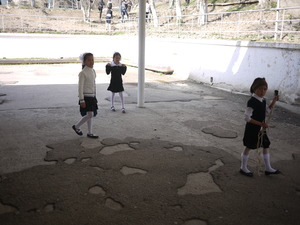
If radioactive particles (albeit small doses not enough to cause health concerns) can journey some 6,000 miles across the ocean, imagine what the town of Mailuu-Suu is like? When local children turn on the tap in their schools, they get water highly contaminated with radiation.

That is because Mailuu-Suu, in Kyrgyzstan, is located downstream from an old uranium mine with piles of toxic radioactive waste left exposed to the elements. Here, the potent pollutant only needs to travel a few miles to reach the town. Mailuu-Suu was on Blacksmith's first-ever list of world's worst polluted places.
P1090396For decades, piles of radioactive waste in Mailuu-Suu have been slowly leaching into the ground, contaminating the land and water, and sickening its 20,000 residents.
Moreover, with each earthquake or heavy rain, there is a danger that a catastrophic landslide will block the river next to the dumpsites, cause a flood, and spread radiation throughout large parts of Kygryzstan, Tajikistan and Uzbekistan. Data collected over 17 years show a clear correlation between cancer and congenital diseases with the level of life-threatening pollution in the town.

While the World Bank works on a long-term plan to protect the dumpsites from flooding, Blacksmith is reducing the risks to the most vulnerable residents by placing water filters in the town's hospital and schools. The cartridge in each filter is designed to remove toxins for three years.  However in Mailuu-Suu, the extraordinary level of contamination renders the cartridges useless in just nine months.

This year, Blacksmith is returning to install filters in three additional schools and replace cartridges in older filters. Since 2008 when the program began, levels of radioactive elements in the water have decreased by between 48% and 65% in the hospital and schools where filters were installed.

Kyrgyzstan's uranium wastes: solution still elusive

Published Date: 11-05-2009
Source Date: 08-05-2009
It's been declared one of the world's ten "worst polluted" places, by the US-based Blacksmith Institute (reporting in 2006). See: http://www.minesandcommunities.org/article.php?a=845
The abandoned uranium tailings piles and plants in Kyrgyzstan - particularly around the town of Mailii-Suu - continue to defy adequate arrangements for neutralising their present dangers and to prevent future disaster.
The dire situation has been covered on the MAC website over the past six years. See: http://www.minesandcommunities.org/article.php?a=1859
In December 2008 we reported that there was no consensus among the 'experts' as to whether these deadly wastes should be removed or 'stabilised' in situ:http://www.minesandcommunities.org/article.php?a=8957
Following a conference held in the Kyrgyz capital Bishkek, earlier this month, which was organised by the UNDP and the government, the first option now seems to have been dropped.

Kyrgyzstan Drafts Plan to Address Soviet-Era Uranium Waste

ENS
7th May 2009
BISHKEK, Kyrgyzstan - Radioactive dust, contaminated groundwater and toxic landslides and floods threaten more than a million people in Central Asia, warned experts at a conference last week.
The radioactive threat stems from 92 toxic waste sites in Kyrgyzstan that contain tailings, or waste, from uranium mining during the Soviet era.
In addition to Kyrgyzstan, neighboring Tajikistan and Uzbekistan are also vulnerable to the radioactive material.
"The state of these tailings, which contain large amounts of highly toxic wastes of uranium - over the tens of years since the shutdown of the facilities, has significantly worsened,"Kyrgyzstan President Kurmanbek Bakiev cautioned in a speech at the conference.
Entitled, "Uranium tailings: local problems, regional consequences, global solutions," the conference was initiated by the Kyrgyz government and was organized with assistance of the UN Development Programme in the Kyrgyz Republic.
The waste sites are relics of the time when the former Soviet Union mined the uranium for use in its nuclear arsenal. Now the sites are an ongoing hazard in the region.
The small town of Mailii-Suu, in the south of Kyrgyzstan, for instance, is marred by two million cubic meters of radioactive waste buried alongside a river flowing through the Ferghana Valley, the most populated and fertile area in Central Asia.

"The USSR's first atomic bomb was made from Mailuu-Suu's uranium," said Torgoev Isakbek Asangalievich, a scientist at Kyrgyzstan's National Academy of Science.
Now, landslides and earthquakes threaten to wash huge quantities of uranium waste into the Ferghana Valley's Syr Darya River.
The poorly guarded sites are visited by local villagers in search of scrap. In one recent incident, three Chinese tourists bought depleted uranium at a flea market in Kyrgyzstan hoping to resell the radioactive material as a souvenir.
Uranium mining towns also have suffered setbacks and pose development challenges since there are few economic opportunities for the people living there. In some areas, women and children graze livestock in contaminated areas.
"Tailings and dump sites are a wonderful place for livestock grazing with lots of grass," said Zharas Takenov, an environmental program officer with the UN Development Programme. "Tailings are covered with flat squares which are also well fit for children's football matches."
Experts worry that earthquakes and related landslides or mudslides could spread the radioactive material to rivers, contaminating the groundwater in Kyrgyzstan, Tajikistan andUzbekistan.
Currently, the uranium tailings are loosely contained in impounding areas and dams.
Takenov warns that an inventory of the condition of these dams has not been conducted in 30 years.
In response to these issues, the Kyrgyzstan government has partnered with the UN Development Programme to work towards proper management of dangerous sites, countermeasures such as recycling and raising public awareness.
Funding for such programs is also critical, particularly in view of the global economic downturn. At the moment, the UNDP estimates roughly US$42 million is needed to rehabilitate the radioactive waste sites and minimize the regional environmental threats.
In 2004, the World Bank approved a seven-year, $6.9 million project to minimize the exposure of people and livestock to radiation from abandoned uranium mine tailings and waste rock dumps in the area around Mailuu-Suu.
Two of the project components are the stabilization of large landslide areas and a program of capacity building to improve the national system for disaster management, preparedness and response. The third component is the establishment of real-time monitoring and warning systems at major landslide areas in Mailuu-Suu and other key hazard areas. That project closes in 2010.
Based on the outcome of the Bishkek conference discussions, a framework document setting forth a plan for future action will be developed for presentation during the International Forum on Uranium Tailings on June 29 in Geneva, which was initiated by President Bakiev.
The plan of action also will be used in the subsequent bilateral and multilateral negotiations between Central Asian nations and donors, international organizations and the private sector. These talks will center on attracting the necessary financial and technological assistance and direct investments to deal with the 92 toxic radioactive waste sites in Kyrgyzstan.
Copyright Environment News Service (ENS) 2009. All rights reserved.

Home | About Us | Companies | Countries | Minerals | Links | Search | Set Date format | Contact Us
© Mines and Communities 2008. Web site by Zippy Info