Jonathan Porritt:
Right now, those who still feel that nuclear power has no role to play in a genuinely sustainable world are completely downcast at having to fight those same old battles all over again – this time with the added problem of a growing number of serious environmentalists who’ve thrown in their lot (holding their noses as they go) with the nuclear option.
It has to be said that there’s no enthusiasm for the fight. How could there be? And at the moment, there’s no clear sense of where the leadership is going to come from. Who is going to rub people’s noses in the continuing scandal of nuclear waste mismanagement, and remind people that this government promised time after time that there would be no expansion of nuclear power in this country until it had sorted out the problems of nuclear waste? Who is going to hold to account politicians and industry leaders for whom secrecy remains ! the default mindset? Who is going to expose the near-fraudulent accounting practices endemic within the nuclear industry that continue to blind people to the true economic costs and penalties involved in nuclear power? Who is going to interrogate the philosophical and moral implications of one generation imposing on the next a set of problems and security hazards for which they themselves have absolutely no solution? And who is going to take on those sincere but utterly misguided environmentalists who’ve “gone nuclear” over the last few years because they feel there’s no alternative?
24 Dash 8th Dec 2009
http://blogs.24dash.com/jonathonporritt/2009/12/08/time-to-renew-fight- against-nuclear-distractions/
Sunday, 13 December 2009


Are People Aware?
Are people aware??
I have been attending a number of very informative lectures in Oldbury, given by eminent specialists in a variety of fields, which have really opened my eyes to the inherent dangers of what Horizon is proposing, to replace Oldbury Nuclear Power Station, both to us as local residents and to the environment.
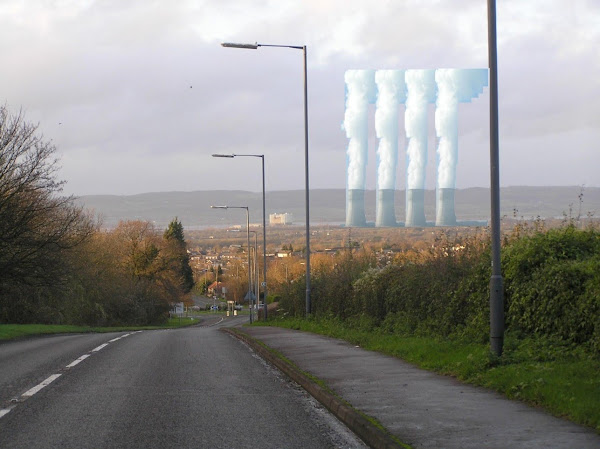
Having seen Horizon’s exhibition, based on their proposal, the most in your face concern is its size and impact on the local area. It is seven times the current output of the existing Oldbury power station. The land acquired is five times the size of the existing site. Either two French designed reactors, of which examples currently under construction in Europe are beset with problems, or three of an American design, are proposed. Both have major cooling requirements. These will need either three or four cooling towers, each of which will be, 200 metres (700 feet tall) and 150 metres in diameter. That’s 2/3rds the height of the Eiffel Tower. Further more, when they are in use, there will be a steam plume on top making it even more visible!!
This proposal is MASSIVE and will affect everybody in this area. The beauty of the River Severn and the Severn Vale will be blighted by the enormity of this structure which, according to Horizon’s own Scoping Report, will be visible downstream as far as Cleveden, up stream to Bishops Cleve, as well as affecting the whole of Thornbury and anybody on the opposite bank from Chepstow through to Gloucester!
So don’t think “well the existing power station is OK so why not have another one.” The above is just one reason why.
We have also learnt, that a recent German government backed study (known as the KiKK report) has confirmed, that there is a severe risk of leukaemia to pregnant women and young children living near Nuclear Power Stations. These findings were such that the German government have apparently decided they will not build any more nuclear facilities. Notwithstanding Eon, which is a German based company, feels free to come and build in the UK. Apparently a report was subsequently issued by HMG and came up with similar findings. However we were told that they decided to leave out a major site, namely Sellafield, from the statistics!! This must lessen the impact and if that is true then you must draw your own conclusions as to the real truth of the matter.
We have also seen reports that the current financial case for these proposals is totally unfounded. One outcome could be that, in the end if these stations are built, the companies involved will have to ask for a UK Government subsidy. It is suggested that this may only happen when the work is well advanced and the UK will be totally reliant on the work being completed to support our future energy needs.
There are many further issues such as, which independent body in the UK will oversee Nuclear safety in future and how little we are spending on renewables (3rd lowest in Europe after Luxembourg and Malta) despite being No1 for natural resources e.g. we have the longest coastline, highest tides, strongest winds etc etc.
I recognise that we have to have power and that we need an urgent solution but my plea is that everybody should inform themselves on these projects so that a considered judgement can me made and it is not solely based on past experience of the Oldbury site. This proposal is VERY different.
Everybody will have an opportunity to make their voice heard over the coming months, in various forums, and I only hope that many more people will take an active interest in this massive topic and its affect on us and our environment.
Allan Taylor
Oldbury on Severn
Thursday, 10 December 2009
Wednesday, 9 December 2009
Map of toxic ships
The Calabria ora daily paper published a map showing thirty odd toxic ships in this italian style bermuda triangle
http://notizie.irgilio.it/cronaca/dove_si_trovano_veleni.html
http://notizie.irgilio.it/cronaca/dove_si_trovano_veleni.html
Thursday, 3 December 2009
Radioactive Shipwrecks
Radioactive Shipwrecks in Italian Waters
By Angela Paine
Nov 14 2009
On 25th October 2009, twenty thousand people marched in Amantea, in the province of Cosenza, Calabria, southern Italy, in protest against the Calabrian Mafia (’ndragheta), who they say have been deliberately sinking ships carrying toxic and radioactive wastes along their coastline.
During the preceding week, trade union representatives from Alto Tirreno, a Region in north Calabria, petitioned the Rome government to deal with these toxic and radioactive shipwrecks. They met with little success.
The Quotidiano della Calabria newspaper collected more than thirty thousand signatures protesting the government’s inertia. The protestors demanded the government to clean up the seabed around Cetraro, Vibo and Capo Bruzzano, (near Brancaleone) the sites of known shipwrecks with radioactive and toxic cargoes. They also demanded the government search for other shipwrecks with radioactive and toxic cargoes, but the ’ndragheta are understood to be blocking investigations in order to prevent more shipwrecks being found.
The radioactive shipwrecks have unleashed a political storm in Calabria. Fisheries and tourism are the two major industries of Calabria, so the contamination of fish and the reduction of tourism threaten the livelihoods of many in this poor Italian region. Interestingly, the seven hundred people killed by the ’ndragheta between 1985 and 1992, the hundreds of ’ndragheta kidnappings, and the scores of ’ndragheta scandals involving most Calabrian politicians, appear to have caused less anger than the alleged radioactive shipwrecks, as this is the first time Calabrians have raised their voices en masse against ’ndragheta.
It is feared that the sinking of ships has gone on for many years, but the issue came to a head on the 12th October, when a wreck was discovered 14 miles off the coast of Cetraro, near Amantea, Calabria. On October 20, an ’ndragheta boss, Francesco Fonti, confessed in an interview published by L’Espresso magazine that he had sunk the Cunski exactly where the wreck was found and that its cargo was radioactive waste. He told L’Espresso that he took orders from multinational corporations to dispose of radioactive waste sent to him in ships.
The Italian government has been aware of shipwrecks containing deadly cargos around its southern coasts since 1994, when Legambiente, an Italian environmental organisation, started an inquest in Reggio Calabria. According to Lloyd’s Shipping Register, 39 ships were sunk in the Ionian sea between 1979 and 1995. Fonti has stated 30 were sunk by the local ’ndragheta.
The inquest first focussed on the ship, Rigel, which sank on 21 September 1987, 20 miles from Capo Spartivento, in the municipality of Brancaleone, near Reggio Calabria. It was believed that the captain, Giorgio Comerio, a go-between for arms dealers, mine manufacturers, and various ‘ndragheta clans, played a pivotal role in the nuclear waste dumping business. This ship was probably carrying radioactive waste, as raised radioactivity levels were found in the sea near the wreck.
The Marco Polo, which sank in the Straits of Sicily between Calabria and Sicily, was carrying a cargo of containers, some of which were found in 1994 along the coast of Campania, the region to the north of Calabria. Scientists found increased levels of radioactive thorium 234 in environmental samples. Presumably the ship was carrying radioactive waste when it sank. The Koraline sank near Ustica, a small island, 53 kilometres north of Capo Gallo, Sicily. Its containers were highly contaminated with thorium.
After months of investigation, the Legambiente inquest began to realise the extent of the contamination of the south Italian coast. However as the evidence of radioactive waste dumping mounted, the Environment Ministry brought the inquest to an abrupt halt and refused to allow the authorities in Reggio Calabria to investigate the ships sunk near Capo Spartivento.
The inquest at Reggio Calabria found contracts in connection with some of the sunken ships. It appears that some European governments may have sent radioactive waste to ’ndragheta clans through intermediaries. The contracts stated that waste should be inserted into steel tubes, inside steel containers with sonar systems, so that they could be found if necessary in the future. The containers were to be deposited 50-80 metres deep in the sea or buried deep on land. The ’ndragheta clans appeared to have decided to avoid all this work and simply sink the ships in the Mediterranean, with the ship-owners subsequently claiming the insurance.
Fonti told L’Espresso “For years, no-one wanted to listen to what I had to say in court. I always admitted that I was involved in dumping this waste in shipwrecks, both toxic and radioactive. I told them where to find the shipwrecks along the coast of Cetraro, and indeed on 12th September, the Calabria Region government ... found one of the ships, the Cunski, exactly where I told them to look.”
A robot operated mini submarine was sent down to photograph the wreck and its cargo. The video showed the old ship with a hole in its hull, through which several barrels could be seen, one of which was empty.
Francesco Fonti explained to L’Espresso how he sank three ships, including the Cunski in 1992. “I put dynamite inside a big lump of concrete on board the ships with a long fuse, then I blew them up. It was easy." He and members of his ’ndragheta clan also sank the Yvonne A at Maratea in the Gulf of Policastro, and the Voriais Sporadais at Melito Porto Salvo near Reggio di Calabria. All three ships were carrying toxic and radioactive cargoes. Fonti said that ’ndragheta had carried out these sinkings for the arms dealer, Ignazio Messina. He added “I sank 3 ships but I know from ’ndragheta bosses that at least 3 other ships were sunk between Scilla and Caribdes, another one near Tropea and others near Crotone. I can’t remember exactly where they sunk the others.”
Fonti said that he worked for various Italian politicians, including De Stefano, Dc Ciriaco de Mita and Riccardo Misasi. Misasi would tell him whether to dump the waste on land or at sea, and Dc Ciriaco de Mita asked him to dispose of waste for the state. “We could get between 4 and 20 billion lire for dumping a load. The money was deposited in a Swiss Bank in Lugano, or in a bank in Cyprus, Malta, Vaduz or Singapore. We did it all through the banker Valentino Foti.” These politicians deny involvement, but the absences of investigation and media coverage are notable.
Although it is tempting to point a finger at the Mafia, Camorra and ’ndrageta in Italy, these perform just the dirty end of a business that originates in other parts of Italy, Northern Europe and other parts of the world. For example, some of these ships were carrying waste for international arms dealers who were paid for the disposal of radioactive waste and who collected money fraudulently from insurance companies when the ships sank. Fonti named some of the arms dealers, including Saud Omar Mugne from Somalia, but Fonti has not yet revealed the origin of all the waste, perhaps because he does not know. He added that ’ndragheta stopped dumping toxic and radioactive waste off the coast of Italy several years ago and started sending ships to Africa, mainly to the coast of Somalia.
Of course, Fonti may not be a credible witness since he is a member of ’ndragheta, under house arrest for drug trafficking offences. But he is not the only person to indicate a link between the radioactive waste business and illegal arms dealing. The Italian journalist, Ilaria Alpi, discovered a link between toxic waste dumping by the Mafia and arms traffic in Somalia. She was killed in March 1994 in Somalia. Her death certificate has disappeared, but a photocopy was found on the property of the arms dealer Saud Omar Mugne. He is suspected of buying and selling arms between East Europe, Italy and Africa. According to Fonti and Ilaria Alpi, he was also involved in the toxic and radioactive waste disposal business. Several secret service operatives from various countries, who were trying to get to the bottom of this affair, were also killed in mysterious circumstances.
The inquest started by Legambiente in 1994 discovered a web of international financiers from big banks involved in a money-laundering programme called the “Roll Programme.” Fonti also points to the involvement of international financiers in the toxic and radioactive waste disposal business, with its links to the arms trade.
Silvestro Greco, a Calabrian Environment Councillor, who attended an emergency meeting at the Environment Ministry in Rome on 22nd October, said the shipwreck discovery should not just be considered a problem for Calabria. ‘‘There are perhaps another 30 ships still missing that were used to hide toxic, harmful and radioactive waste,’’ he said. ‘‘This pollution is a problem for all areas, not just those along the coast, because illegal trafficking in waste knows no international boundaries’’. He pointed out that ‘‘the entire Mediterranean, from the Adriatic Sea to the Tyrrhenian Sea, and from the Straits of Sicily to the Aegean Sea’’ was damaged by the sinking of toxic waste ships. ‘‘Cleaning and removing the load will be particularly complex in terms of financing, given that a vast area is involved,’’ Greco added. ‘‘In our opinion, the European Union should get involved, as well as the Italian government”.
Mario Pirillo, a Calabrian Member of the European Parliament, together with seven other MEPs, filed an official request with the European Commission on Tuesday asking for its assistance. The request pointed out that Italian investigators believed the Cunski was sunk by an international criminal network involved in Europe-wide illegal waste disposal. It is important to recall that Italy only ever had one small nuclear power station. So though some of the radioactive waste in these shipwrecks may have originated in Italy, most almost certainly did not.
Then suddenly, on the 29th Oct, the environment minister, Stefania Prestagiacomo, held a press conference in Rome to announce that the shipwreck found at Cetraro was not a ship carrying a cargo of radioactive waste. It was the Catania, a passenger ship, which sank in 1917. The attorney Grasso then announced that the inquest into the Cetraro shipwreck was closed.
This, however, was not the end of the story. L’Espresso, once again, delving into the matter, interviewed Pippo Arena, the pilot of the remotely operated vehicle. He said that when he inspected the shipwreck near Cetraro in September, he saw two hulls and they were full of barrels. “Full of what I don’t know, but full” he said. This is in sharp contrast with the results of the other inspection, carried out from the ship, Mare Oceano, also off the coast of Cetraro. The shipwreck Catania that they found here had empty hulls. The two videos showed shipwrecks of different sizes, and the coordinates of the first shipwreck and those of the Catania demonstrated that they were about three and a half miles from each other. It was beginning to look as if there were more than one wreck off the coast of Cetraro.
This was born out by evidence recently leaked from the unpublished minutes of a meeting in the Italian parliament on 24th January 2006, to discuss the iniquitous waste recycling business. It emerged from this document that there were three shipwrecks off the coast of Cetraro, not one. None of the measurements of the three ships corresponds to the measurements of the Catania, the wreck found by the Mare Oceano. At the time, the MP Franco Greco told the commission that the fishermen of the area had found some barrels in the sea. So many questions have been raised that the WWF has entered the fray:
“There are inconsistencies between the declarations of the Environment Minister and the Region of Calabria and the report of the pilot of the ROV, who said that the two hulls of the boat during the first inspection were full whereas the Dda of Catanzaro talked about one ship with one empty hull,” a WWF spokesperson said.
So the WWF, which on the 2nd of November already officially requested a public comparison of the two inspections, repeated their request to Environment Minister Stefania Prestigiacomo and the head of the national antimafia organisation Piero Grasso. They asked to be allowed to choose experts to compare the two videos made by the ROV. They also want the coordinates to be taken into consideration, and the technical details of the ships that were found. The Environment Minister responded by putting the two videos on the website “for complete information, transparency and so that the public can make comparisons.”
Clearly the mystery surrounding the toxic and radioactive shipwrecks off the coast of Calabria remains. The Italian Government, despite continued calls from the Green Party and many other MPs to get to the bottom of it, appear to be dragging their feet. But since there are clear indications that the waste business is international, Italy should not be left to deal with this problem on her own. The European Union should be involved, both to provide funding and expertise.
(URLs as of 11 Nov 2009)
http://unoenessuno.blogspot.com/2009/10/blu-notte-navi-perdere.html
This blog talks about the book The Lost Ships. Police detective Commander Natale de Grazia died suddenly while investigating shipwrecks carrying nuclear and toxic waste. There is a picture of the red ship, Jolly Rosso, that landed on the beach. It had a cargo of nuclear waste, which was spirited away. The ship was broken up and taken away in lorries. No one knows where the nuclear waste went, but a quarry near the beach is now radioactive.
http://current.com/items/90187321_le-navi-dei-veleni.htm
This discusses 30 ships that disappeared. Some were found and observed to have increased levels radioactivity near them, but there is no political will to remove their cargoes.
2009/10/20 http://www.youtube.com/watch?v=qfvu_r0FPQ0&feature=related
A spokesperson for the Italian environmental organisation, Legambiente, talks about the international traffic in nuclear and toxic waste. Many countries pay to get rid of their waste, which ends up being dumped by ’ndrangheta (the southern Italian equivalent of the Mafia)
2009/10/20 http://www.youtube.com/watch?v=ZT90O1D7p5s&feature=related
This shows an interview with the former ’ndrangheta boss, Francesco Fonti, who confessed that he blew up three old ships carrying toxic and radioactive wastes, off the coast of Italy. He told the authorities exactly where to find them, and they found one, where he said. It had a cargo of radioactive waste. The Government sent down a mini submarine to take photos of it but don’t want to do anything about it.
http://www.youtube.com/watch?v=NXSJHjMkx8I
This shows local fishermen protesting about the damage to their livelihoods. They ask how can we live when the fish are radioactive and tourists will not want to come to our beaches again.
http://www.youtube.com/watch?v=WxhtBxlGHYo&feature=related
This shows the people in charge of the inquest, and the two journalists who were beginning to uncover the link beween the illegal sale of arms and radioactive and toxic waste dumping in Somalia before they were murdered.
http://www.youtube.com/watch?v=Tj3lbBjz1BM&NR=1
http://www.youtube.com/watch?v=15ks8HRRJ5s&feature=related
These show the shipwreck found fourteen miles off the coast of Calabria, five hundred metres deep. There are holes in the side of the ship and you can see some of the barrels of radioactive cargo, one of which is empty. Calabria Region hasn’t got the money or the expertise to do anything about it.
http://www.youtube.com/watch?v=NwQztx0OVL8&NR=1&feature=fvwp
video-footage of a shipwreck 12 miles from Molfetta with a highly toxic cargo.
http://www.ilmanifesto.it/archivi/commento/anno/2009/mese/10/articolo/1698/
www.ANSA.it The main Italian press agency
http://www.regione.basilicata.it/osservatorioambiente/default.cfm?dir=45&doc=161&fuseaction=doc
Public enquiry on waste recycling for the Basilicata Region
http://www.camera.it/_dati/leg14/lavori/stenografici/sed491/aurg01.htm
Parliamentary Request by the foreign minister, the environment minister and the justice minister for an enquiry into the international network of toxic and radioactive waste traffic
http://www.parlamento.it/parlam/bicam/rifiuti/Sedute/02.htm
Public enquiry into the illegal disposal of toxic and radioactive waste.
Riccardo Bocca; "Naufragio radioattivo" (Radioactive Shipwreck); L’Espresso, 9 September 2004, page.34 onwards
Riccardo Bocca; Indagini Radioattive - colloquio con Paolo Russo (Radioactive Enquiry – interview with Paolo Russo); L’Espresso, 16 September 2004, page.76 onwards
Riccardo Bocca; Nella memoria si è aperta una falla - colloquio con Gianfranco Messina (There seems to be a crevasse opening up in the collective memory – interview with Gianfranco Messina.) L’Espresso, 23 September 2004, pag.76 onwards
http://notizie.virgilio.it/notizie/cronaca/2009/11_novembre/06/nave%20veleni%20%20min%20%20ambiente%20%20su%20sito%20visionabili%20filmati%20%20%20%20%20-2-,21515162.html
Toxic ships. The pilot of the robot operated submarine raises doubts about the second film. So the environment minister puts both films on the website.
http://www.radio.rai.it/GRR/view.cfm?Q_PROG_ID=421&Tematica=1&V_IDNOTIZIA=54884
Navi al veleno, buone nuove a Cetraro (Poison Ships, good news at Cetraro) by Paolo Poggio ROMA 29/10/09 - 20:13
http://magazine.quotidianonet.ilsole24ore.com/ecquo/ecquo/2009/11/02/navi-dei-veleni-wwf-incongruenze-nei-punti-nave/
WWF asks for a new enquiry
Subscribe to:
Posts (Atom)
