Thursday, 24 March 2011

Nuclear lessons from Japan

From Tehelka Magazine, Vol 8, Issue 12, Dated 26 Mar 2011 Saturday, March 26 2011 by Praful Bidwai
Fukushima has highlighted the supreme importance of nuclear safety. Governments, especially in the West, cannot afford to ignore public concerns about safety. Switzerland has cancelled its plans to build three new reactors. And Germany’s conservative government has reversed its controversial decision to prolong the phaseout of all nuclear reactors. Nuclear authorities in many countries are questioning the assumptions on which they designed reactor safety systems and operating parameters. But in the Indian Department of Atomic Energy (DAE), complacency and smugness prevail. Its secretary denies that there is “a nuclear emergency” in Japan, only “a purely chemical reaction”. Prime Minister Manmohan Singh promised a safety review of all DAE installations. He said his government “attaches the highest importance to nuclear safety”; the DAE has “been instructed to undertake immediate technical review of all safety systems… particularly with a view to ensuring that they would be able to withstand… tsunamis and earthquakes”. That’s a red herring.

But the DAE’s internal review of our (Indian) nuke programme is likely to be a whitewash job

THE FUKUSHIMA disaster has spun out of control with explosions in three reactors, a fire in a fourth, and huge radioactivity releases. The Japanese government has finally admitted to the gravity of the crisis and said there is “a very high risk” of further radioactivity leaks from the crippled reactors. Prime Minister Naoto Kan made a television address pleading for calm and said: “I would like to ask the nation, although this incident is of great concern, I ask you to react very calmly.”

The disaster, verging towards catastrophe, is still unfolding. But it is clear that it is far, far worse than the Three Mile Island meltdown (1979) in the US. In its lethal effects, it may not match the Chernobyl meltdown of 1986 in Ukraine, whose anniversary falls on 26 April. Chernobyl caused an estimated 32,400 to 1,10,000 deaths, mainly from cancer. But in its economic, industrial and psychological impact, the Fukushima disaster is likely to be far more powerful and far-reaching than Chernobyl.

Put simply, Fukushima is the global nuclear industry’s worst-ever crisis. Chernobyl was “in the East”. The meltdown could be attributed to faulty designs and shoddy practices in a relatively backward society. The argument doesn’t apply to industrially advanced Japan.

Japan is a world leader in nuclear power, with 55 reactors, next only to the number in the US and France. Unlike them, it has had an active, albeit now declining, nuclear power programme. It ventured into ‘high-end’ fast-breeders just when France, once a breeder leader, abandoned its programme. The Fukushima reactors are of US design (General Electric). The global economic, industrial and emotional impact of the Fukushima disaster, which the world public followed virtually in real time, will be immeasurably greater.

That apart, Fukushima has highlighted the supreme importance of nuclear safety. Governments, especially in the West, cannot afford to ignore public concerns about safety. Switzerland has cancelled its plans to build three new reactors. And Germany’s conservative government has reversed its controversial decision to prolong the phaseout of all nuclear reactors. Other countries too are likely to review their nuclear expansion plans. It’s a safe bet that the ‘nuclear renaissance’ that George W Bush tried to instigate through artificial subsidies will now be a non-starter.

Nuclear authorities in many countries are questioning the assumptions on which they designed reactor safety systems and operating parameters. But in the Indian Department of Atomic Energy (DAE), complacency and smugness prevail. Its secretary denies that there is “a nuclear emergency” in Japan, only “a purely chemical reaction”. Prime Minister Manmohan Singh promised a safety review of all DAE installations. He said his government “attaches the highest importance to nuclear safety”; the DAE has “been instructed to undertake immediate technical review of all safety systems… particularly with a view to ensuring that they would be able to withstand… tsunamis and earthquakes”.

That’s a red herring. The DAE has already declared that all its installations can cope with magnitude 7 earthquakes and heavy tsunamis. It reiterated that the very afternoon Singh made his statement in Parliament. It can be safely predicted that an internal review will be a whitewash job. The Indian public has reason to be alarmed at the Japanese crisis: reactors at Tarapur are also Boiling Water Reactors designed by General Electric, the same as Fukushima’s, only smaller, one-generation older, and probably with weaker safety systems.

The DAE must be made to discard the hubristic “it-can’t-happen-here” approach and introspect into India’s nuclear safety record: embarrassing failures like the 1993 fire at the Narora reactor, the Kaiga containment dome collapse, cases of radiation over-exposure at numerous sites, unsafe heavywater transportation, and terrible health effects near the Jaduguda uranium mines and the Rajasthan reactors.

We urgently need an independent, credible safety audit of India’s nuclear programme, in which people outside the DAE participate, pending a radical review of India’s half-baked plans to rush into nuclear power expansion. To begin with, there must be an immediate moratorium on further reactor construction, including the controversial untested French reactors that India is planning to install at Jaitapur in Maharashtra.

India's Nuclear Neros

 Outlook Magazine  Saturday, March 19 2011  by Praful Bidwai

The colossal hubris, ignorance and smugness of India’s nuclear czars take one’s breath away. The day Japan’s crisis took a decisive turn for the worse, with an explosion in a third Fukushima reactor and fresh radiation leaks, Department of Atomic Energy (DAE) secretary Sreekumar Banerjee declared that the nuclear crisis “was purely a chemical reaction and not a nuclear emergency as described by some section(s) of media”. Nuclear Power Corporation chairman S.K. Jain went one better: “There is no nuclear accident or incident. It is a well-planned emergency preparedness programme which the nuclear operators…are carrying out to contain the residual heat after…an automatic shutdown”.
N-power isn’t the low-risk option the deceitful, inept DAE says it is

The colossal hubris, ignorance and smugness of India’s nuclear czars take one’s breath away. The day Japan’s crisis took a decisive turn for the worse, with an explosion in a third Fukushima reactor and fresh radiation leaks, Department of Atomic Energy (DAE) secretary Sreekumar Banerjee declared that the nuclear crisis “was purely a chemical reaction and not a nuclear emergency as described by some section(s) of media”. Nuclear Power Corporation chairman S.K. Jain went one better: “There is no nuclear accident or incident. It is a well-planned emergency preparedness programme which the nuclear operators…are carrying out to contain the residual heat after…an automatic shutdown”.

This is proof, if proof were at all needed, that our nuclear power programme is in the hands of men who are totally cut off from reality and have a default conviction in their own omniscience and infallibility. Their denials are as despicable as their pathetic parroting of the virtues of India’s nuclear installations and their safety.

Let’s get this straight. The Fukushima crisis is the world’s worst nuclear accident since the Chernobyl meltdown in 1986. The earlier (partial, largely contained) meltdown at Three Mile Island (1979) pales beside it. The Fukushima reactors have spewed large amounts of radioactivity into the air. The vessel containing the core of Reactor 2, which fully lost water cover for hours, has been damaged. The fire in Reactor 4 released yet more radiotoxins. At the time of writing, only a miracle can prevent further radiation release.

The Fukushima disaster is the world’s first multi-reactor crisis; controlling it is more difficult. It also poses three special problems. Large quantities of spent fuel, containing extremely radioactive nuclear wastes, are stored in pools in the reactor building, following General Electric’s design. These are no longer being cooled. A spent fuel leak, spreading due to the flooding, could have unspeakably lethal effects.

Second, Fukushima reactors’ primary containment—similar to India’s Tarapur reactors, also GE-designed—has been found by a US laboratory to be vulnerable to molten fuel burning through the reactor vessel, eventually breaking out. Third, Reactor 3 burns a mix of uranium-plutonium oxide (MOX). Researchers say mox generally increases the consequences of severe accidents with large radioactivity releases, resulting in a five-fold increase in latent cancer fatalities.

Even if the Fukushima crisis doesn’t worsen further, it highlights the inherent hazards of nuclear power, in which small individual mishaps can precipitate a runaway crisis. The reactors were shut down by the earthquake; and their still-hot cores were no longer cooled. The diesel back-up came on, but went out in an hour. The loss of coolant led to the explosions and radioactivity releases.

That this happened in industrially advanced Japan, with high nuclear safety standards, underscores the gravity of the generic problem with nuclear reactors. They are all vulnerable to a catastrophic accident irrespective of safety measures. Nuclear power generation is also bound up with radiation exposure, harmful in all doses, and radioactive waste streams, which remain hazardous for thousands of years.

India’s nucleocrats have been in denial of these problems and suppressed their abysmal safety record. The list of failures is long: a serious fire at Narora, which moved from the turbine to the reactor room amidst panic-driven abandonment of fire-fighting procedures; collapse of a containment-dome safety system at Kaiga; frequent radiation exposure of workers and lay public to doses above the permissible; and the spiking of drinking water with deadly tritium in Kaiga. India has the distinction of running two of the world’s most contaminated reactors.

This necessitates a radical reform of the DAE, the government’s worst-performing department, which has never completed a project on time and within budget. We must have an independent, credible nuclear safety audit, with outside experts and civil society representatives. We must review our nuclear power policy for appropriateness, safety, costs, and public acceptance, based on a holistic view of the best ways of meeting our energy needs. If nuclear power emerges as the least desirable option, we should discard it. The environment ministry must also revoke all conditional clearances granted to nuclear projects, including Jaitapur.

Nuclear power has subjugated our energy policy and budgets to an unaccountable, self-perpetuating, pampered technocracy, imposed unacceptable hazards upon unwilling populations, and degraded our democracy. The juggernaut must be halted.

(Praful Bidwai is a columnist and activist of the Coalition for Nuclear Disarmament and Peace.)

http://www.prafulbidwai.org/index.php?post/2011/03/19/India-s-Nuclear-Neros

Monday, 21 March 2011

Germany decides to shut down aging nuclear power plants

European Commissioner for Energy Guenther Oettinger addresses the media after a hastily convened meeting of energy ministers, nuclear regulators and industry officials in Brussels, Tuesday, March 15, 2011

Earlier Tuesday, German Chancellor Angela Merkel said that seven reactors that went into operation before 1980 would be offline for three months while Europe's biggest economy reconsiders its plans to extend the life of its atomic power plants.


One of them, the Neckarwestheim I reactor, would remain shut down for good. Residents said living in the shadow of the 35-year-old nuclear plant is making them increasingly nervous in the wake of the events in Japan.

"It must be switched off," 32-year-old Anja Pfau told AP Television News as she pushed her 5-month-old boy along the street in a pram. "There are enough alternative energies like water power and solar energy."

A previous government decided a decade ago to shut all 17 German nuclear reactors by 2021, but Merkel's administration last year moved to extend their lives by an average 12 years. That decision was suspended for three months.


Canada’s nuclear regulator says a leak at a power plant caused 19,000 gallons of demineralized water to be released into Lake


Toronto, NY -- March 16, 2011,
Charles McChesney / The Post-Standard

The Canadian Nuclear Safety Commission says there is no significant risk to public health,
 but do we believe them?

The water was released from the Ontario Power Generation plant in Pickering, Ontario, Monday and the commission was informed around 11:30 p.m. that day. The agency says the leak was caused by pump seal failure.

"The event was a low-level regulatory event with only negligible effect to the environment and no public health implications," Ontario Power said in a release.

Well they would say that wouldn't they! Low level means radiactive water was released and radioactive water gets into the environment and stays there, causing damage.

http://www.syracuse.com/news/index.ssf/2011/03/officials_canadian_nuclear_pla.html

EnergyNuclearIndustry divided over long-term impact of Japanese nuclear crisis


UK nuclear developers counsel caution as experts remain at odds over whether disaster will herald global slow-down in nuclear build plansBy Will Nichols     15 Mar 2011

The escalating crisis at the Fukushima nuclear facility in Japan has prompted a range of responses from industry experts and environmentalists with some predicting the disaster will herald an end to nuclear build programmes and others expressing confidence the sector can learn the lessons from the events in Japan.

The crisis at the plant is still on-going with reports this morning of a third explosion that has resulted in dangerous levels of radiation and further stoked fears that the reactors' fuel rods could go into meltdown.
Obama promises to tackle fuel prices, makes case for "energy independence"However, while the full scale of the threat has yet to be assessed, the dramatic pictures from the earthquake and tsunami-affected plant have been used to reopen the debate around the efficacy of nuclear power.

Friends of the Earth executive director Andy Atkins said the explosions demanded "an urgent rethink" of new-build nuclear, while Tom Clements, the NGO's South East area campaign co-ordinator in the US, said he also expected a reassessment of nuclear policy.

Speaking to BusinessGreen, Clements said he had already received calls from ratings agencies worried about the reputational and investment risks of new nuclear plants.

"The only positive thing to come out of this is that I believe it will cause a renewed interest both by industry and the public in renewable energy and energy efficiency," he said. "This is going to persuade the financial investors to move away from this risky technology."

Simon Powell, head of sustainable research at CLSA in Hong Kong, also forecast a major shift in national nuclear policies.

"I don't think nuclear is going to be done away with, but it is likely that people's nuclear programmes will be delayed as they question whether it is the right thing to do," he told news agency Reuters.

His comments came as a number of government's moved swiftly to review or suspend their plans for new nuclear plants.

British Energy and Climate Change Secretary Chris Huhne has already instructed the UK's chief nuclear inspector, Dr Mike Weightman, to report on the implications of the situation in Japan. Meanwhile, the scheduled launch of an indepedent report that was expected to highlight the benefits of nuclear power and call for a new long-term strategic nuclear plan for the UK was yesterday postponed.

Across the Atlantic, influential independent Senator Joe Lieberman, chair of the homeland security panel, said over the weekend that the US should "put the brakes on" building new plants until the impact of the Fukushima incident is clear.

These events prompted global political risk analysts the Eurasia Group to issue a note warning new-build programmes could be put on the backburner in Britain and the US.

In Europe, the Swiss government has already announced it will put approvals for three nuclear plants on hold so safety standards can be revisited, while German Chancellor Angela Merkel said the government would suspend an agreement that would have extended the life of the country's nuclear power plants.

India and South Korea have also announced reviews of their nuclear programme, while officials in Malaysia signalled that they too could delay their proposed nuclear programme.

However, John Kemp, Thomson Reuter's energy analyst, warned that too much could be read into what are essentially political decisions to delay permits.

"Delaying permits for a few months is neither here nor there – nobody wants to be approving permits on the day of an explosion," he told BusinessGreen. Kemp added it was impossible to tell what the long-term impact would be on the industry or on alternative sources of energy until the outcome of the explosion was known.

"If the reactors leak, then that would make a nuclear revival less likely."

However, he was not convinced that additional funds would be ploughed into renewables as a result of the crisis and cautioned that moving away from nuclear would damage countries' attempt to meet energy security and emissions goals

"If we don't replace reactors with more nuclear, we have to burn more fossil fuels or undertake severe demand reduction strategies," he said. "Long term, it's very much up in the air and the question for regulators is if you don't do nuclear, what's the alternative?"

EDF and E.ON, the UK's two largest nuclear operators, both told BusinessGreen that it was too early to make decisions on whether to re-evaluate their investments and that they would wait for the results of the government review.

"We welcome the fact the UK government has asked the safety regulator to report on the implications of the events in Japan," EDF said in a statement. "EDF Energy is happy to support this work in whatever way it can to ensure lessons are learned. The nuclear industry puts great weight on learning from any such events."

Industry body the Nuclear Industry Association was unable to comment before going to press.

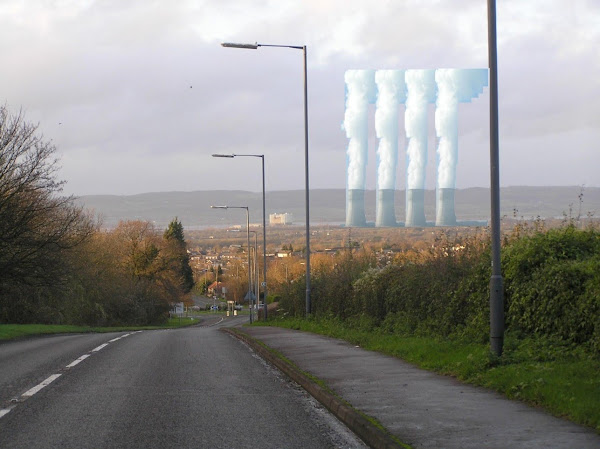
Oldbury on the 17th March 2011


This was taken from the other side of the Severn, showing Oldbury letting off steam.
Why?
What was in the steam?
Anything radioactive???

Sunday, 20 March 2011

Nuclear power and earthquake hazard in the UK


Introduction

The UK is not a country generally associated in the public mind with earthquakes. However, while the UK is nowhere near in the same league as high seismicity areas such as California and Japan, it nevertheless has a moderate rate of seismicity, sufficiently high to pose a potential hazard to sensitive installations such as nuclear power stations, dams and chemical plants.
The distribution of British earthquakes in space
The study of British earthquakes has in the past been somewhat neglected compared to some other countries, not necessarily those with more active seismicity.
Up to the 1970s, the most recent publication attempting to survey the whole history of British earthquakes was still Davison's catalogue of 1924 even though this was now 50 years out of date.

Modern instrumental monitoring of British earthquakes began around 1970 with the establishment of LOWNET by the Global Seismology Group of BGS (then IGS) which has subsequently expanded to the present country-wide monitoring network, supported by a customer group led by the Department of the Environment. This led to routine macroseismic surveying of British earthquakes from 1974 onwards, and the beginnings of reinvestigation of historical seismicity at about the same time by Roy Lilwall.

In the early 1980s, the expansion of the nuclear power programme in the UK led to increased activity in revaluating historical seismicity both from macroseismic and instrumental records, and major studies were made by several investigators independently, including BGS, Imperial College London, and private consultancies. All this work was combined and synthesised in the early 1990s to make a consistent, numerate earthquake catalogue for the UK, which was published by BGS in 1994.

A map of earthquakes in the UK


Above we see a map of earthquakes in the UK, taken from the BGS catalogue. It is clear from this map that the spatial distribution of earthquakes is neither uniform nor random. For example, in Scotland most earthquakes are concentrated on the west coast, between Ullapool and Dunoon, with the addition of centres of activity near the Great Glen at Inverness and Glen Spean, and a small area around Comrie, Perthshire, and extending south to Stirling and Glasgow. The Outer Hebrides, the extreme north and most of the east of Scotland are virtually devoid of earthquakes. For the north-west of Scotland the absence of early written records, the small population, and the recent lack of recording instruments means that there may be a data gap; for instance, there are indications that an earthquake occurred in 1925, possibly near Ullapool, with magnitude probably about 3½ ML, for which there are no first-hand reports. However, many other parts of Scotland, especially south of the Highland line, are quite well-documented, at least since 1600, and therefore the lack of earthquakes is genuine.

Further south a similar irregularity is seen. If one draws a quadrilateral from Penzance to Holyhead to Carlisle to Doncaster, most English and Welsh earthquakes will be included within it. The northeast of England seems to be very quiet; almost aseismic. The southeast has a higher rate of activity, with a number of earthquakes which seem to be "one-off" occurrences. The most notable example of these is the 1884 Colchester earthquake, a magnitude 4.6 ML event which was the most damaging British earthquake in at least the last 400 years, and yet which occurred in an area (Essex) otherwise more or less devoid of earthquakes from the earliest historical period up to the present day.
There are also important centres of activity near Chichester and Dover. The former produced a swarm-like series of small, high-intensity earthquakes in the 1830s and was active again in 1963 and 1970.

Offshore, there is significant activity in the English Channel and off the coast of Humberside. Because only the larger events in these places are likely to be felt onshore, the catalogue in the pre-instrumental period is probably under-representative of the true rate of earthquake activity in these zones. Even after the introduction of seismometers, offshore earthquakes may still have gone unnoticed on account of the distance to the nearest instruments. The Central Grabens of the North Sea are now known to be active features, only because of the improvements in instrumental monitoring over the last fifteen years.
Certain centres can be identified as showing typical patterns of activity. For example, the Caernarvon area of north-west Wales is one of the most seismically active places in the whole UK. Both large and small earthquakes, usually accompanied by many aftershocks, occur at regular intervals. The most recent of these larger events was the earthquake of 17 July 1984 (5.4 ML), which was one of the largest ever UK earthquakes to have an epicentre on land and had a very protracted aftershock sequence. Two further felt earthquakes have occurred there since, on 29 July 1992 (3.5 ML) and 10 February 1994 (2.9 ML). It is tempting to ascribe several early earthquakes of unknown epicentre (eg that of 20 February 1247) to this area just because it seems to be such a favoured site for large earthquakes.

In South Wales, on the other hand, although a line of epicentres of significant events can be traced from Pembroke (an earthquake in 1892) to Newport (active in 1974), only the Swansea area shows consistent recurrence, with significant earthquakes occurring in 1727, 1775, 1832, 1868 and 1906. (Given this periodicity it may be that a further earthquake in this area is due in the near future.) The Hereford-Shropshire area has also produced large earthquakes in 1863, 1896, 1926 and 1990, but none of these share a common epicentre.

The area of the Dover Straits is particularly significant because of the occurrence there of two of the largest British earthquakes in 1382 and 1580 (both of magnitude about 5¾ ML). Since 1580 the only earthquakes there have been much smaller, raising the question of whether there is a danger of another 1580-style earthquake in the near future. The area may be structurally continuous with a zone of activity running east through Belgium, in which case it could be argued that stress in this area since 1580 has been released further east. This does not rule out another 1580-type earthquake in the future, but it is impossible to estimate how soon it might occur.

In the north of England seismic activity occurs over a more or less continuous area from Leicester to Carlisle. The most prominent centres of repeating activity here are the upper end of Wensleydale (with significant earthquakes in 1768, 1780, 1871, 1933 and 1970) and to a lesser extent the Skipton area.

What is remarkable is the lack of correlation between this pattern and the structural geology of the UK.

Tectonic sketch map of the UK


This map shows the major crustal subdivisions in the UK. The boundaries between areas of moderate or high seismicity and areas of very low seismicity do not correspond to any major structural feature; for instance the sharp dividing line running SE from Inverness. And the major boundaries shown above are not clearly reflected in the pattern of seismicity either as dividing lines between zones of differing rates of seismicity nor as lineations marked by earthquakes. It seems likely that the pattern of seismicity may be influenced by the distribution of ice during the last glaciation - certainly for Scotland this appears to be the case.

The distribution of British earthquakes in time

log N = a - b M  where N is the number of earthquakes per year exceeding a given magnitude M. The constant a reflects the absolute level of seismicity in an area, and the value of b has generally been found to be consistently close to 1.0.

Magnitude frequency plot for the UK

 It has long been realised that larger earthquakes occur less frequently than smaller earthquakes, the relationship being exponential, ie roughly ten times as many earthquakes larger than 4 ML occur in a particular time period than earthquakes larger than magnitude 5 ML. This can be expressed by the Gutenberg-Richter formula


This holds true for the UK. The graph above shows an analysis for the area 10o W to 2o E and 49o N to 59o N. This deliberately excludes the northern North Sea area which is of high seismicity and completely under-represented in the catalogue before 1970 because of the impossibility of detecting smaller events in this area before that date. A least-squares regression to this data gives the relationship log N = 3.82 - 1.03 M

Also shown is an alternative doubly-truncated exponential model which gives a curved fit ot the data at the higher magnitude end.

One can therefore draw the following conclusions about average recurrence - the UK may expect:

an earthquake of 3.7 ML or larger every 1 year
an earthquake of 4.7 ML or larger every 10 years
an earthquake of 5.6 ML or larger every 100 years.

Seismic hazard calculations

Seismic hazard calculations in regions of low seismicity, such as the UK, are generally based on probabilistic methodology. Probabilistic seismic hazard assessment (PSHA) uses a combination of interpreted geological and seismological data to calculate the probability that a certain level of ground motion will be exceeded, or not exceeded, in a given period of time.

This methodology can be divided into three principal components as follows:

(i) Definition of a set of seismic source zones which define the geographical variation of earthquake activity. These source zones are based on the distribution of observed seismic activity together with geological and tectonic factors and represent areas where the seismicity is assumed to be homogenous; ie there is an equal chance that a given earthquake will occur at any point in the zone.

(ii) An understanding of earthquake recurrence with respect to earthquake magnitude, as described in the previous section.

(iii) An attenuation relationship is required which defines what ground motion should be expected at Location A due to an earthquake of known magnitude at Location B. The rate at which the strength of shaking decreases with distance from an earthquake's epicentre varies regionally and has to be calculated or estimated. Peak ground acceleration (pga) is the measure of earthquake shaking most used by engineers in this country. However, it has two disadvantages - firstly, the attenuation of pga in the UK is very poorly known, and secondly, pga is actually not a particularly good measure of the actual expectation of damage. A useful alternative is intensity, which is an expression of ground shaking in terms of its effects. The attenuation of intensity in the UK is very well documented, and intensity is directly proportional to damage, making it a very meaningful parameter.

The intensity attenuation model used here is expressed by the formula

I = 3.32 + 1.44 ML - 3.34 log R,  where ML is local magnitude and R is hypocentral distance in kilometres.

Seismic hazard studies in the UK in the past have been mostly single-site studies for particular installations. The first attempt to look at hazard for the UK as a whole using the PSHA methodology was conducted by Ove Arup around 1991. This study calculated hazard at eleven representative sites in the UK. Following this, a study to produce contour maps of UK seismic hazard was commissioned by the Department of Trade and Industry, and was carried out by BGS and AEA Technology. In this study the computer code SUNMIC was used, which allows a "logic tree" model to be applied to the hazard, by which uncertainty in input parameters can be modelled by the inclusion of multiple choices each with a weighting value).

Seismic hazard results

Here is a sample hazard map of the UK, based on the study made for the DTI.


Intensity hazard map for the UK

The map shows intensities that are 90% likely not to be exceeded in 50 years - equivalent to a return period of 475 years. For guidance, a simplified equivalence of the intensity values (on the European Macroseismic Scale) is as follows:

3 - Felt by few
4 - Felt by many indoors, windows and doors rattle
5 - Felt by most indoors, small objects fall over
6 - People run out in alarm, slight damage to buildings (plaster cracks)
7 - Moderate damage to buildings (chimneys fall, cracks in walls)

As might be expected, the areas of highest hazard parallel the areas where earthquakes have been most common in the past, but particularly those places where repeated earthquake activity has been highly localised - this localisation has a pronounced effect on the hazard calculations compared to areas where the seismicity, while high, is more diffuse and less repetitive. The zones where hazard is higher than average encompass the W Highlands of Scotland, an arcuate zone running from Carlisle to Pembroke, NW Wales and W Cornwall. The places in the UK with lowest seismic hazard are Northern Ireland (especially the western counties) and outlying parts of Scotland, including the Orkneys and Outer Hebrides.

The actual values of hazard are not particularly high, since the predicted intensity for the higher zones is only 6 EMS. In other words, even in areas of relatively high exposure to earthquakes in the UK, if a facility has a life of 50 years there is only a 10% chance that it will experience shaking equivalent to intensity 6. Moving briefly from hazard to risk, if we take as a guideline that probably less than 5% of buildings of normal construction (eg conventional brick houses) will be damaged in a place when the intensity there is 6, the probability of damage for a single house in 50 years is therefore less than 0.5%.


Roger Musson

25 June 2003