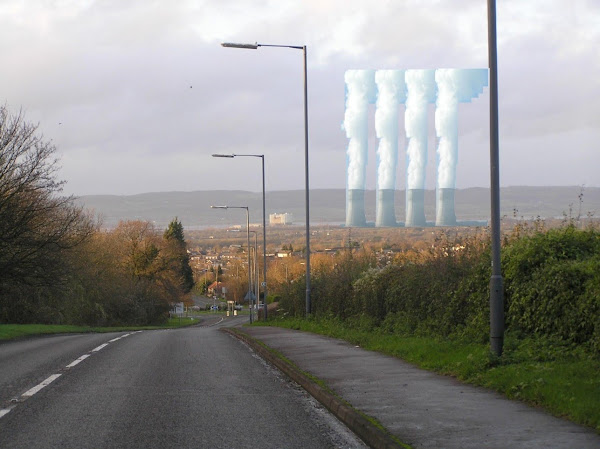
Opponents of nuclear power joined hands to form a 120-kilometer human chain across northern Germany. They were protesting Chancellor Angela Merkel's decision to revoke a law that would shut down nuclear plants by 2020.
Tens of thousands of people attended demonstrations on Saturday aimed at protesting the German government's plans to extend the lives of its nuclear power plants.
Demonstrators formed a 120-kilometer (74-mile) human chain that stretched from a nuclear power plant in Brunsbuettel, near the city of Koblenz, through Hamburg along the Elbe River to another plant in Kruemmel, on the North Sea.
Kruemmel was the site of two minor nuclear accidents in 2007 and 2009.
Police in the German state of Schleswig-Holstein told the AFP news agency that there were "clearly more than 100,000 participants." Organizers estimated the total number at about 120,000.
"Today over 120,000 people have signaled to the government: You must change your pro-nuclear position," event spokesman Thorben Becker told the DPA news agency.
Demonstrations also took place at an atomic waste storage site in the town of Ahaus in North Rhine-Westphalia and at a nuclear plant in the state of Hessen.
German Chancellor Angela Merkel has said that her center-right coalition wants to revoke a law passed under Chancellor Gerhard Schroeder's center-left coalition that promised to shut down all nuclear power plants in Germany by 2020.
Merkel's government has called nuclear energy a "bridge technology" that helps the country keep its commitments to lowering carbon dioxide emissions.
The protests come just days before Monday's 24th anniversary of the Chernobyl nuclear disaster.
Deutsche Welle - 24.04.2010
Sunday, 25 April 2010


Saturday, 24 April 2010
Have the Finns gone completely mad?
Press Release - for immediate publication Friday, April 23rd, 2010
Finnish Governments Proposal for Two New Reactors: Crazy and Irresponsible Infotour will educate citizens about the nuclear threats around the Baltic Sea
On Wednesday the Finnish government announced that they will put a proposal to build two new nuclear reactors in Finland to the Finnish parliament: an additional plant at Olkiluoto in the Eurajoki region and a NPP for "Fennovoima", the German joint venture with several Finnish companies to establish a third nuclear site in Finland in addition to Olkiluoto and Loviisa. No-one but the nuclear industry needs more nuclear power plants in Finland. It's a shame that the Finnish authorities seem to be in bed with the nuclear companies.
Helsinki The Finnish government's incomprehensible decision to support further new reactors has met with harsh criticism from anti-nuclear activists across Europe and beyond. The government is obviously willing to sacrifice people's health and the environment to the nuclear industry's profits. Anti-nuclear groups around the Baltic Sea plan an information tour in the summer, to educate about the impacts of nuclear facilities on the environment and people living in the region and to raise the awareness of the dangers associated with nuclear power.
Campaigner and activist Falk Beyer: "It's a crazy and irresponsible position to ask for more nuclear power plants increasing the radioactive releases to the Baltic Sea and the risk of serious accidents. These reactors would also produce large quantities of nuclear waste - even though no safe solution for the long-term storage
of this waste is possible. The Scandinavian concept of final disposal is scandalous - to dump the toxic and radioactive waste by the sea, hoping that their artificial measurements could prevent the release of these dangerous materials is a gamble with the entire region's future."
An information tour about the affects of the nuclear power plants, waste repositories and uranium sites around the Baltic Sea will visit 13 cities in eight countries between June 22nd and August 21st. The tour will provide information about the radioactive contamination of the Baltic Sea in public information events, draw public attention to the dangers of nuclear power with street actions and strengthen the networks of anti-nuclear organizations and activists around the Baltic Sea through regional network gatherings.
The infotour "Stop Nuclear Power - Baltic Sea Info Tour 2010" will start on the Åland islands in Finland to emphasize the international awareness about the nuclear developments in this country. It will support the local anti-nuclear movements in their fight against a powerful global nuclear industry that attempt to push a so-called "Nuclear Renaissance" on the world by using Finland as an example. The anti-nuclear movements will make plain to the Finnish government that they have to expect strong resistance against their nuclear expansion.
"We will start the infotour in Finland at the end of the parliamentary season, before the politicians begin their summer break. And we will be back in Finland at the end of the 'Stop Nuclear Power - Baltic Sea
Info Tour' in late August to make sure that the anti-nuclear resistance is on the spot when the parliament starts working again. We won't let them have a break to force the nuclear threat on Finland."
The Baltic Sea is - according to the experts of the countries around it - the most radioactively polluted water body in the world. Besides the Chernobyl fallout and the releases from the Sellafield nuclear facility in the UK the nuclear power plants in Sweden, Finland and Russia are the most responsible polluters. The proposed new NPPs, uranium mining and final disposal sites will increase the radioactivity released to the Baltic Sea irresponsibly.
Details about the "Stop Nuclear Power - Baltic Sea Info Tour" are available at http://baltic-tour.nuclear-heritage.net . Background information about nuclear issues and resistance in several countries around the world is available on the website: http://nuclear-heritage.net/
Dear editor:
Contact us at media[AT]nuclear-heritage.net or call Falk Beyer at +358 41 7243254.
Nuclear Heritage Network Am Baerental 6
D-04720 Ebersbach GERMANY
WebSite: http://nuclear-heritage.net/
E-Mail: contact[AT]nuclear-heritage.net
This media release is provided by the "Nuclear Heritage Network". It is an international network of anti-nuclear activists. This informal alliance supports the worldwide anti-nuclear work. The Nuclear Heritage Network is no label, has no standard opinion and no representatives. All activists of the network speak for themselves or for the groups they represent.
New Nuclear – The Economics Say No
UK Green Lights New Nuclear – Or Does It?
Green lighting new nuclear? — The UK government today announced a fast-track planning process for new nuclear power stations. 10 sites have been approved for possible development. The government is presenting today’s announcement as providing the green light for a major new nuclear programme, which it says is needed to meet climate change and security of supply targets.
But no financial support has been offered — The government has not announced any direct financial support for new nuclear. The government still seems to expect the private sector to take an unacceptable level of risk, in our view.
The five big risks — Nuclear power station developers face five big risks:
Planning, Construction, Power Price, Operational, and Decommissioning. The government today has sought to limit the Planning risk. While important for encouraging developers to bring forward projects, this is the least important risk financially.
The three Corporate Killers — Three of the risks faced by developers — Construction, Power Price, and Operational — are so large and variable that individually they could each bring even the largest utility company to its knees financially. This makes new nuclear a unique investment proposition for utility companies.
No where else in the world — Government policy remains that the private sector takes full exposure to the three main risks; Construction, Power Price and Operational. Nowhere in the world have nuclear power stations been built on this basis.
Nor will they be built in the UK — We see little if any prospect that new nuclear stations will be built in the UK by the private sector unless developers can lay off substantial elements of the three major risks. Financing guarantees, minimum power prices, and / or government-backed power off-take agreements may all be needed if stations are to be built.
2 Citigroup Global Markets
The UK government today (9 Nov 2009) launched a fast-track planning process for a new generation of nuclear power plants in the UK. The government has selected 10 sites that will be taken forward by the new Infrastructure Planning Commission for approval. Planning inquiries will still be required but will deal with local issues only.
The UK government has presented this today as effectively “green lighting” the build of new nuclear stations. However, this is in fact far from the case.
The Five Risks
There are five substantial areas of risk faced by developers of new nuclear power stations. Three of those risk areas are so big and significant that if they go wrong, the developer (even the biggest utilities) could be financially damaged beyond repair. These risks can be classed as Corporate Killers. The government today announced measures to limit Planning risk, which while important in encouraging developers to bring forward projects, is actually the least significant risk financially. The government is still asking the utility companies to take on the three major risks — Construction, Power Price, and Operational. Indeed, at no time, anywhere in the world, has a utility built a new nuclear power station and taken the full Construction, Power Price, and
Operational Risk.
The five risk areas are:
1. Planning: Nuclear power remains controversial and opposition to new developments often results in extended planning procedures. In a lot of countries, planning can take five years or more. The UK government’s action today is designed to limit this time frame, reducing the risk faced by developers. However, while an expiated planning process is essential in encouraging developers to bring forward projects, it is in fact the least risky element in the development process from a financial perspective. Developers will have spent some money acquiring a site (which could probably be used to build a
conventional power station if planning consent for a new nuclear plant is refused) and will commit time and a few £10m’s to the planning process. While annoying for the developers if this turns out to be wasted time and money, in no way would a failed planning application threaten the financial integrity of a utility company.
2. Construction: Below we give the latest data on the current and future costs of building a new nuclear power station. The latest evidence suggests a cost range of €2,500/kW to €3,500/Kw. For a 1,600MW
unit, that means a construction cost of up to €5.6bn. We see very little prospect of these costs falling and every likelihood of them rising further. The cost of the TVO plant in Finland has increased from €3.0bn to €5.3bn since construction started. It has also proven to be very difficult to predict how long a new plant will take to build. The TVO plant is also running three years late. Cost overruns and time slippages of even a fraction seen by TVO would be more than enough to destroy the equity value (and more) of a developer’s investment unless these costs can be passed through somehow. Given the scale of these costs, a construction programme that goes badly wrong could seriously damage the finances of even the largest utility companies.
New Nuclear Development – Corporate Risks
Planning is the least risky element from a financial perspective. We see very little prospect of construction
costs falling and every likelihood of them rising further.
3. Power Price: Nuclear power stations have very high fixed costs and relatively low variable costs. Their cash flows and profitability are therefore particularly sensitive to the price that they sell their power. As we show later, even at the low end of the build cost estimates, we calculate that a new nuclear station will require €65/MWh (£58.5/MWh) in real terms year in/year out to hit its breakeven hurdle rate. As we show in Figure 5, the UK has only seen prices at that level on a sustained basis for 20 months of the last 115 months. It was a sudden drop in power prices that drove British Energy to the brink of bankruptcy in 2003. No nuclear power station has ever been built to our knowledge where the developer takes the power price risk.
4. Operational: Because of their high fixed cost base, nuclear stations are also very vulnerable to shortfalls in output due to operational unreliability. A six-month breakdown can cost £100m’s in direct costs and lost output, particularly if the output has been pre-sold. This risk is too great for a single project to bear, in our view, and at the very least needs to be spread across a portfolio of assets.
5. Decommissioning / Waste: Nuclear plant operators set aside money in order to pay for decommissioning and the disposal of waste. Estimates of these costs can jump around by many £bn’s depending on what
discount rates are used, etc. The UK government is proposing adopting the “pay as you go” approach used successfully in the USA amongst other countries. Basically a tax will be paid on each MWh produced (probably as little as £1/MWh). This would effectively limit the risk faced by the developers. In our view, it is extremely unlikely that private sector developers will be willing or able to take on the Construction, Power Price, and Operational risks of new nuclear stations. The returns would need to be underpinned by the government and the risks shared with the taxpayer / consumer. Minimum power prices (perhaps through capacity payments), support for financing, and governmentbacked off-take agreements may all be needed to make new nuclear viable.
Update on Cost Estimates
Construction costs are very difficult to quantify, but are a key factor in new nuclear affordability economics. Third-generation plants are meant to provide better performance with lower initial capital costs. However, as we noted in our previous note on European Nuclear Generation (see ttps://www.citigroupgeo.com/pdf/SEU20085.pdf), we believe that construction delays and cost overruns could sharply increase the quoted capital costs for new nuclear and lead to value destruction and lower returns to equity investors.
Both Westinghouse and Areva claim to be able to construct a new thirdgeneration plant (AP-1000 and EPR, respectively) in 3 years from first pouring of concrete. However, evidence to date suggests this is not necessarily the case, as Olkiluoto and Flamanville projects have both suffered delays, while the first AP-1000 unit under construction, in SanMen China, is running significantly over its $1,000/KW construction cost target and is expected to be over $3,500/KW target on current estimates.
We calculate that a new nuclear station will require €65/MWh (£58.5/MWh) in real terms year in year out to hit its breakeven hurdle rate. The returns for new nuclear development will need to be underpinned by the
government and the risks shared with the taxpayer / consumer.
Evidence to date suggests time delays in new nuclear construction can be significant. Georgia Power stated in mid 2008 that two 1100MW reactors would cost up to $14 billion, depending on financing terms. This gives significantly high cost assumptions of $6,360 per kilowatt.
In November 2008, Tennessee Valley Authority updated its estimates for Bellefonte units 3 & 4 relating to two AP1000 reactors of 2234MW combined. It said that overnight capital cost estimates ranged from $2,516 to $4,649/kW for a combined construction cost of $5.6 to $10.4 billion.
Towards the end of 2008, at its investor day, EdF increased its cost assumptions for the Flamanville 3 EPR, raising them to €4 billion/$5.6 billion or €2,434/kW or $3,400/kW in real money terms. These costs were confirmed in mid 2009, when EdF had already spent nearly €2billion. Another estimate from Nuclear Innovation North America, in June 2009, said that the cost of two 1350 MW GE ABWR units at the South Texas Project near Houston would be about $10 billion, including financing costs. This would be a merchant plant, not a regulated one, operating on cost plus basis with the first unit expected on line in 2016. This equates to $3,700/KW.
The Finnish EPR at Olkiluoto has been plagued by many delays during construction and is currently 3 years behind schedule, having originally targeted commissioning in 2009. The original cost estimate for Olkiluoto was €3bn. However, due to delays, planning problems (construction started in 2005), and issues with materials, Areva’s latest estimate (August 2009) is that costs have risen by €2.3bn and could increase further depending on the outcome of negotiations between the owner, TVO, and Areva on the timeline for completion. Therefore at a running total of €5.3bn, costs stand at €3,300/kw ($4,785/KW) and although this is the first EPR project, and teething troubles ought to be expected, it is still indicative of the risks that we think equity investors should be concerned about.
Also, in May 2009, MIT published an update of its 2003 study into construction costs of large-scale engineering projects. The report stated that "since 2003 construction costs for all types of large-scale engineered projects have escalated dramatically.” In addition, according to the report, the estimated cost
of constructing a nuclear power plant has increased at a rate of 15% per year heading into the current economic downturn. This is based both on the cost of actual builds in Japan and Korea and on the projected cost of new plants planned for in the United States. The overnight capital cost was given as $4,000/kW, in 2007 money.
This vast range of figures for new nuclear construction costs suggests that there is a high degree of uncertainty and therefore risk in this part of the project. In a regulated framework this is less of an issue for economic viability (but still a political and social issue) as construction costs can be recovered through higher regulated tariffs. However, in a purely merchant market (such as the UK) where wholesale power prices need to cover construction costs over the life of the project, there is no active way for a developer to recover cost
overruns. It is this scenario that we believe threatens value and returns to equity investors.
As we have stated previously, there is a possibility that governments intervene in the wholesale markets to ensure power prices remain sufficient to reward new investment, but at this stage it is unclear whether this would be the case and how such intervention would work.
Construction delays and planning problems have led to a 77% increase in construction costs at the Olkiluoto site. In a purely merchant market (such as the UK) where wholesale power prices need to cover construction costs over the life of the project, there is no active way for a developer to recover cost overruns.
The Energy Bill recently passed by the US Congress recognises such risks and provides production credits of 1.8 cents per KWh for the first 3 years of operation, equivalent to the subsidy provided to the wind generation segment.
Debt & Equity Financing Environment Improving
The recent stabilisation in economic data and recovery in the equity and debt markets has had a positive effect on the financing environment, as CDS have contracted and appetite for corporate debt has increased, bringing yields down.
Figure 1 shows the IBOXX Utilities Bond price index since 2004. Although still some way below the peak in late 2005, the recovery over the past year shows that credit costs for utilities should have eased, although we would point out that the high capital risks associated with new nuclear construction may lead to higher cost of debt than other conventional power plant projects.
The risks are significantly higher for equity rather than debt investors, with leverage likely in these projects at least 50:50%.
Figure 2 shows the trend in overall market equity risk premium (ERP) over the past 5 years. Although off its highs, the ERP is still high compared to 2006-7 and contributes significantly to higher WACC in new projects. Due to the uncertainties on timing and cost, we believe nuclear projects should have a higher ERP than the overall market.
Due to the uncertainties on timing and cost, we believe nuclear projects should have a higher ERP than the overall market.
On the back of our observations on the trading levels of the debt and equity markets and our assessment of the risks involved, we believe a 4.5% post-tax cost of debt and a 12.5% cost of equity on a 50:50% gearing are appropriate, which provide an 8.5% post-tax WACC for the project.
Moody’s has recently issued a statement saying that it is considering taking a more cautious view toward issuers that are actively pursuing new nuclear generation, as history gives reason to be concerned about possible balance sheet challenges and the substantial execution risk. “In order to defend existing ratings, or to limit negative rating actions, we will look for investorowned utilities to create strategic partnerships, to share costs and risks, and to increase reliance on equity as a component to financing plans. We would also expect them to moderate their dividend policies to retain cash flows”.
We believe new nuclear is a classic example of divergent interests between credit and equity investors that also create a vicious circle. The inherent risk causes credit investors to seek increased funding from the equity side. However, with cost of capital the major determinant of break-even prices, an increased equity injection increases the power price required, therefore increasing the risk of failure, hence increasing the credit market’s aversion for such projects. We expect utilities to try to seek support and assurances from involved governments, however we continue to argue that the risk/reward without such explicit support is skewed against equity investors.
Load Factors Not To Be Taken For Granted
A key aspect of the economics of new nuclear plants is the assumed and achieved load factors that a plant is expected to reach. EDF is targeting an availability factor of 85% for its existing operational nuclear plants.
In Figure 3, we show EDF’s reported operational factors and our estimates to 2012E. We note that EDF in the past 5 years has consistently reported load factors below 80%.
Moody’s has issued a statement saying that it is considering taking a more cautious view toward issuers that are actively pursuing new nuclear generation.
Inherent risk in new nuclear development causes credit investors to seek increased funding from the equity side
In the US in the 1970s and 1980s, when previous generations of nuclear plants were built, load factors were consistently below 70%. This perhaps reflects the inexperience of dealing with new nuclear reactor technology at that time, a factor that could well impact new third-generation plants in future years.
Figure 4 shows the load factors of the US reactors between 1973 and 2008 and the increasing trend towards 90%. The main reason for this is that the US utilities recognised that the plants were not economically viable without increasing the load factors and therefore undertook programs to boost
utilisation. However, a plant built in 1990, with a useful life of 40 years, would have been operating at below 80% load factor for the first 8 years of its life, a scenario that threatens the economic viability of new nuclear plants.
With the recent experiences of the UK nuclear plants as well, we do not believe equity investors should take design specifications as 100%-proof, at least from year 1.US utilities recognised that the plants were not economically viable without increasing the load factors and therefore undertook programs to boost utilisation
Bottlenecks in Construction a Rising Obstacle
India and China are both targeting huge increases in nuclear generation over the next couple of decades.
On 7th September, Japan Steel Works, the sole maker of certain atomic reactor parts, more than doubled its forecasts for China’s nuclear plant construction. It now sees scope for China to have built 22 reactors by end 2010 and 132 reactors thereafter, compared to an original estimate from last year for a total of 60 reactors. We remind readers that the Chinese government has given approval for 25.4GW of new nuclear capacity, with 9.1GW currently on operation. Japan Steel Works is in the process of expanding its capacity from 5.5 units equivalent p.a. to 12 by March 2012 at a cost of ~$900m. This expected growth in China is very important for the ambitions of utilities on new nuclear in Europe. China’s central planning of the projects, government support and rising GDP are likely to make this a priority market for constructors.
Later in September, the Indian Prime Minister, Manmohan Singh, predicted that India could produce 470 gigawatts of nuclear power, making India the largest nuclear energy producer in the world. India's 17 reactors currently produce 3.8 gigawatts of power and while the contribution of nuclear energy is expected to rise from just 3 percent to 6 percent of India's total needs over the next decade, it is expected to increase to between a third and a half of the country's energy needs by 2050, according to the new forecast announced by Singh. The ability to execute this will be highly dependent on the availability of nuclear developers, materials and experienced labour, and could create bottlenecks in construction, pushing back development timelines by several years, a factor that would severely hinder the prospect of a new nuclear project providing adequate returns to equity holders.
With significant bottlenecks, not least because of Japan Steel Works’ paramount position in the parts chain, European plants could well fall behind. We continue to argue that unless we see strong government commitment on new nuclear projects in Europe, they are unlikely to come on line according to existing timetables.
Licensing
The new nuclear program in the UK is likely to be delayed as the UK Nuclear Installations Inspectorate (NII) published a statement (April 2009) saying it has serious reservations about the safety of Areva’s EPR reactor design. The NII has written to EDF and Areva highlighting concerns around the control and
instrumentation systems in the design. The NII said the EPR technology was compromised due to interconnections between systems that should be independent.
Neither the UK nor the US have yet approved any designs and although it will be a lengthy process anyway, amendments and additional configurations for each country's demands could be highly problematic.
Neither the UK nor the US have yet approved any designs and although it will be a lengthy process anyway, amendments and additional configurations for each country's demands could be highly problematic. This also remains an issue for other regions where each individual government may request additional design modifications to grant the licence, something that would greatly add to cost and remove one of the supposed construction efficiency advantages of having a standardised design across territories. Additionally, even with government intervention on power pricing, we would be surprised if governments allow a return to be made not only on the theoretical investment but also on the budget and time overruns, effectively burdening the consumer with the cost of any inefficiencies in the planning system or actual execution by the utilities
The NII called on the companies to submit an initial response by May 22, and then a full answer by the end of August 2009, although the HSE has not yet published a statement saying it has received the necessary responses. The recent HSE update report states that the target for completion of design assessment is 2Q 2011, in line with previous estimates. We do see scope, though, that due to licensing issues and regionally-customised design specifications, new nuclear power plants could take longer to be built than the timeframe planned and therefore cost more.
Grid and Back-up Capacity Costs
Taking the UK as an example of commitment to new nuclear generation, we look at the ability of the grid system to cope with such increases in generation from single sources. With the potential for 4-8 new plants to be built in the UK over the next 20 years, the current maximum grid connection of 1320MW and in the absence of simultaneous switch off of existing nuclear facilities, significant grid upgrades may be required to avoid overload in the event of the Areva EPR becoming the chosen standard for new nuclear build in the UK. The only reactor in the UK currently in operation with a power rating over 1000MW is Sizewell B with a power rating of c. 1250MW. The Areva EPR and other advanced PWRs have power ratings in the region of 1000-1700MW. Similar issues would be faced in other countries and anecdotal evidence has suggested that the preference of the smaller reactors over the EPR in China related partly to the reduced impact on the network.
The UK has already provided some cost budgeting work, with National Grid estimating that, should all existing nuclear power plants be replaced, an extra £1.4bn of spend would be required to reinforce the transmission network.
Additional spinning reserve costs would have to be considered ,with PB Power quoted as saying that for every new EPR build in the UK, an additional 260MW of spinning reserve would be required at £1.3-2.1/MWh.
This also raises issues in the areas of planning for new substations, overhead power lines, site connection and gaining public approval for this infrastructure. In some cases, public opposition is significantly higher in regards to highvoltage power lines than for the nuclear plants that generate the electricity.
Dale Klein, chairman of the US NRC, has stated previously that necessary grid extensions and upgrades could lead to further delays of nuclear projects and indicated that he was surprised to learn that "it may take as long to site, permit, and build a transmission line for a new plant as to site, license, and build the plant itself."
The UK has already provided some cost budgeting work, with National Grid estimating that should all existing nuclear power plants be replaced an extra £1.4b of spend would be required to reinforce the transmission network.
Land Costs
The auction for three UK sites for possible development for new nuclear is reported to have netted the UK government £387m.
The RWE / E.ON consortium acquired two sites, Wlyfa in North Wales and Oldbury in South West England. Edf acquired the third site, Bradwell in England. No breakdown of the prices paid for the three sites has been released yet, so is it unclear whether or not the payments will be made immediately or at least partly deferred to when construction begins. The RWE / E.ON consortium confirmed that is intends to
build up to 6,000MW of new nuclear in the UK.
What it all means for shareholders
Scenario 1: Plant built on time and on budget
On the assumption that the total cost, inclusive of construction, financing, development and land purchase, of a 1600MW nuclear plant will be at €5bn, i.e. €3,125/KW, and that within 5 years the nuclear plants reach their maximum availability potential, we estimate that power prices need to be at €65/MWh for investors to earn a reasonable positive return (100bps over cost of capital).
Scenario 2: Plant built with delays
On the assumption of a 20% cost overrun (i.e. €3,580/KW) and 2-year time delay in construction and achievement of peak load factors, we estimate that power prices need to be at €70/MWh for investors to earn a similarly competitive positive return.
https://www.citigroupgeo.com/
Thursday, 22 April 2010
From Russia with Love
Construction of the Russia’s first floating nuclear power plant continues. The vessel is designed to provide nuclear power in remote regions of the Arctic and should according to plan be completed in 2011.
The floating power plant “Akademik Lomonosov”, named after the famous Arkhangelsk scientist Mikhail Lomonosov, is being constructed at the Baltiysky Zavod yard in St Petersburg. At the moment, the vessel is being protected against hull corrosion, web site Motorship.com writes.
Construction of the vessel began at the Sevmash yard in Severodvinsk in April 2007, but in August 2008 Rosatom transferred the assignment to the Baltiysky Zavod in Sankt Petersburg. Construction is planned to be completed in 2011, and the vessel will then be towed to a position off the coast at Vilyuchinsk, a town in the Kamchatka region in the far east of Russia, according to Wikipedia.
Russia plans to build five such floating nuclear plants. Construction of the second vessel has been announced to start in autumn 2010. In February 2009 Rosatom and the Republic of Yakutia signed an agreement for implementing investments to build four floating nuclear power plants for use in the northern coastal areas of the Siberian Republic.
A floating nuclear power plant can operate for 40 years and need refueling only once in 10 years.
http://www.barentsobserver.com/construction-of-floating-npp-goes-as-planned.4776471-116321.html
Monday, 19 April 2010
Fasting-and-Action, Paris, April 26 to May 7, 2010 for the abolition of nuclear weapons
We need you ! We need your support, and more : for you to come to our Fasting-and-Action in Paris !
From all over the world, activists will travel to New York for the Review Conference of the Non Proliferation Treaty ! Some will come to Paris. Because France opposes nuclear disarmament !
A Convention for Elimination of Nuclear Weapons has to be agreed. We want France to support it.
Organizers
This action is planned to be in Paris on the initiative of the Maison de Vigilance Taverny and in partnership with Réseau Sortir du Nucléaire, the collective Armes Nucleaires STOP, and the 2nd City district of Paris. It involves a number of anti-nuclear organizations including ICAN-France and linked Nuclear Disarmament campaigns.
Background
The Review Conference of the Non-Proliferation Treaty (NPT) will take place in New York in May 2010. The international community has expressed its readiness to engage in a nuclear disarmament process following the policy statements of Barack Obama. Only France has expressed opposition to its participation in this process. Moreover, the General Assembly of the United Nations in 2007 supported the principle of a Convention to eliminate nuclear weapons, the Parliament of the European Union made a similar recommendation in April 2009, and many groups and public figures have underlined its urgency, but countries with nuclear weapons are all reluctant to consider it ... except for China. The possibility of nuclear disarmament is good news but, paradoxically, decisions that might lead to its implementation are far from being taken.
250 French citizens will be present at the UN in New York during the opening of the NPT Conference, May 3, 2010.
Goals
This "Fasting-and-Action" aims to put pressure on politicians by French media and public opinion so that France is persuaded to announce its decision to accept the idea of a nuclear weapons convention during the NPT Review Conference.
Housing : Mongolian yurts, the town hall courtyard of the 2nd arrondissement of Paris, 24 rue de la Banque
Program (in progress)
Monday, April 26, 19:30: Town Hall 2nd, roundtable "Nuclear disarmament and France" with Christiane Taubira (tbc), Dominique Lalanne, General Bernard Norlain, member of Global Zero, a signatory of the Nuclear disarmament appeal with Michel Rocard, Alain Juppé and Alain Richard
Tuesday, April 27: Beginning of the Fasting in Mongolian yurts in the courtyard of City Hall. Personalities are expected (tbc): José Bové, MEP, Yves Cochet, MP, Michele Demessine, Senator Hélène Luc, Honorary Senator, Jacques Muller, Senator Marc Stenger, Bishop of Troyes, Christiane Taubira, MP.
Thursday, April 29: interview request to the Town of Paris for the fasters and their supporters
Friday, April 30: presence at the nuclear Air force Base of Taverny
Saturday 1st May: Participation in the demonstration on May 1st with entertainment giant puppet
Sunday, May 2: Roundtable : public hall of the 2nd district, 18:30-21:30: "The great religions and nuclear disarmament". With (tbc) Bishop Marc Stenger, president of Pax Christi France, the rector of the Paris Mosque, the Grand Rabbi of France, a representative of the Buddhist Union of France.
Monday, May 3: Fontaine Saint Michel ceremony of the Flame of the abolition of nuclear weapons for the opening of the Review Conference of NPT
Tuesday, May 4: duplex with New York events at the beginning of the NPT Conference
Wednesday, May 5: Screening of "The Bomb": 19:00, in a Mongolian yurt, City Hall of the 2nd
Friday, May 7: interview request to the Ministry of Defense and the presence before the Department of Defense as does Maison de Vigilance once per month for demanding the abolition of nuclear weapons. Meal breaking the Fasting at 14:00 offered by Mayor of the 2nd.
Daily: presence in front of the Fountain Saint Michel for the abolition of nuclear weapons, from 14:00 to 18:00
Contact: lamaisondevigilance@orange.fr web site : www.maisondevigilance.com / projets.htm
Saturday, 17 April 2010
What ate we going to do with our nuclear waste?
EU adviser on nuclear policy Jan Haverkamp said: “The only way to address the problem of nuclear waste is to not produce it in the first place. Despite the decline of nuclear power over the last decade, the industry still creates more radioactive waste than it can deal with. It has tried dumping it in the sea, attempted storage in geological formations, and in copper and clay containers, but nothing has worked. It’s time to put an end to this madness.”
The European Commission is currently preparing a directive on nuclear waste that could make
European countries think twice before they add to the problem by building new nuclear power
plants. However, the legislation could also be exploited by the nuclear industry to attempt to
overcome the stumbling block of public opposition and give politicians a false sense of security
that could open the door to new projects. This briefing illustrates why for now – and for the next
hundreds of thousands of years – the nuclear waste problem is here to stay and why we should
stop wasting our time with nuclear power.
Timeline
April-May: public consultation on the nuclear waste directive:
http://ec.europa.eu/energy/nuclear/consultations/2010_05_31_fuel_waste_en.htm
July: Commission publishes draft proposal
Summer: first reading by the European Parliament
Autumn: Council debate
End of 2010 / early 2011: adoption of the directive
For over 50 years the nuclear industry has produced large volumes of hazardous radioactive
waste, not just from the operation and decommissioning of nuclear power plants, but also from
uranium mining and enrichment. Today, nuclear energy is being sold to politicians and
consumers as one of the solutions to climate change that will also deliver energy security for
Europe. However, nuclear energy is a dangerous obstacle on the road to a clean energy future.1
On top of other substantial problems related to safety and costs, nuclear waste remains a
major flaw of nuclear energy.
The International Atomic Energy Agency (IAEA) estimates that the industry annually produces
one million barrels (200 000 m3) of what it considers ‘low and intermediate-level waste’ and
about 50 000 barrels (10 000 m3) of the even more dangerous ‘high-level waste’.2 These
numbers do not include spent nuclear fuel, which is also high-level waste.
It takes 240 000 years for radioactive plutonium to decay to a level that is safe for human
exposure, which is longer than modern humans have been on the Earth (200 000 years). There
is no way to guarantee to keep these substances safe for this long. It does not make sense to
allow the nuclear industry to continue producing more nuclear waste.
1 In its ‘Energy [R]evolution’ scenario, Greenpeace shows that renewables (like wind, solar, biomass, geo-thermal, tidal and
wave energy) and energy efficiency deliver faster, cheaper and cleaner solutions. Sven Teske, e.a., Energy [R]evolution –
A Sustainable Global Energy Outlook, Amsterdam (2008), Greenpeace/EREC,
www.greenpeace.org/international/press/reports/energyrevolutionreport
2 IAEA Factsheet: Managing Radioactive Waste, 1998, www.iaea.org/Publications/Factsheets/English/manradwa.html
Greenpeace European Unit, vzw-asbl
Belliardstraat 199 Rue Belliard, 1040 Brussels, Belgium
Tel.: +32 2 274 1900 Fax: +32 2 274 1910
european.unit@greenpeace.org www.greenpeace.eu
Ond.Nr./Num. D’entreprise: 0457563648
FAILED SOLUTIONS
Billions of euros have been spent over the past half-century on finding a solution to the nuclear
waste problem. Without success.
Russia, USA, France, UK, Netherlands, Japan and others – waste dumping at sea banned
For years, low level radioactive waste was dumped at sea, 'out of sight and out of mind'.
Disintegrating barrels brought the waste back into the environment, and dangerous substances
accumulated in the bodies of animals. After 15 years of campaigning by Greenpeace, in 1993 an
international treaty was signed banning all dumping of radioactive waste at sea.
USA – seismic fault line compromises bedrock storage
Construction of the Yucca Mountain nuclear waste site in Nevada, USA, began in 1982. The US
Geological Survey has found a seismic fault line under the site and there are serious doubts about
the long-term movements of underground water that can transport deadly contamination into the
environment. As a result of these problems, the US government stopped funding the project in
early 2010.
Germany – Water floods salt layers solution
In Asse, Germany, an experimental radioactive waste dump was set up in the 1960s in salt
formations deep underground. It started leaking water in 1988 and is currently flooding with
12 000 litres of water per day. As a result, all 126 000 barrels of waste already placed in the dump
now need to be cleared out. Asse was meant as a pilot project for a final storage solution in the
salt layers under Gorleben, but there is now serious doubt in Germany about the viability of salt
layers as storage for nuclear waste.
France – Waste inventory unknown
One of the largest nuclear dumps in the world, the Centre de Stockage de La Manche (CSM) in
northern France, was opened in 1969 to store low level waste. It was closed in 1994. It currently
stores 520 000 m3 of radioactive materials from waste reprocessing (see below) and French
nuclear reactors. A 1996 commission set up by the French government concluded that the site
also contained long-living waste and higher level waste, and that the true inventory was effectively
unknown. In 2006 it was found that contaminated water from the site had been leaking into an
underground aquifer, threatening contamination of the surrounding agricultural land.
NEW RESEARCH BRINGS NEW CHALLENGES
Forsmark, Sweden – Olkiluoto, Finland: copper corrosion
Sweden is developing a system that places nuclear waste in a copper container surrounded by
clay. Water is expected to help the copper container harden when it is stored in rock like granite,
deep underground. Finland adopted the same system and Switzerland and the UK are considering
this option. But problems have already begun to appear. The copper canisters were expected to
survive corrosion for 3 000 years, but recent research shows that they might fail in 300 years.3
There are furthermore concerns about the build-up of hydrogen produced as a result. High
temperatures from the canisters could also affect the clay covering, while groundwater flows could
bring contaminants from any compromised containers into the Baltic Sea. Furthermore, studies
predict that Nordic countries are likely to face at least one ice age in the coming 100 000 years,4
which could change the pattern of the underground and ground water streams.
Bure, France – Dessel, Belgium: uncertainties of clay as a natural barrier
Unlike Sweden and Finland, that rely on man-made barriers to prevent leakage, France and
Belgium are exploring clay as a natural barrier. The waste is to be contained in simple stainless
steel canisters, which can corrode even more easily than the Swedish copper ones, and rely on
the natural clay formation to keep in radioactivity. The crucial question is whether it can be
guaranteed – for hundreds of thousands of years – that no cracks or channels will form in the clay
layers, which would cause water to leak in and out and poison nearby aquifers.
3 Hultquist, G. et al. (2009). Water Corrodes Copper. Catalysis Letters, Volume 132, Numbers 3-4.
http://dx.doi.org/10.1007/s10562-009-0113-x
4 Matti Saarnisto, Evaluation report on the Posiva report 2006-5 (2008), STUK (Finland's nuclear regulating agency).
Available on demand.
THE HUMAN RISK OF STORAGE
Human interference
Once placed into final storage, nuclear waste needs to be monitored and not only secured from
natural events, but also from human interference. Stored civilian and military nuclear waste, such
as plutonium or uranium, are the most accessible sources of radioactive material that can be used
for the production of nuclear bombs. A few kilograms of these substances would be sufficient to
make bombs similar to the ones used on Japan by the US military during World War II. Even a very
modest amount of radioactive material from these sites (around 20 grams) would be sufficient to
make a 'dirty bomb’, which could contaminate several square kilometers. To deal with the
problem, the nuclear industry proposes to guard storage sites for 300 years. But there is no
proposal to ensure security for the other 239,700 years.
Interim storage: leakage and terrorist risk
Some countries, like the Netherlands, have set up interim storage for 100 years, effectively shifting
the problem of final storage to our grandchildren and great-grandchildren. In the meantime,
leakages and accidents need to be prevented. An additional risk is terrorism: an attack on an
interim nuclear waste storage site would be a relatively soft target for terrorists.
Reprocessing – the myths of the ‘nuclear cycle’
The nuclear industry talks about the 'nuclear fuel cycle' and claims that after use, nuclear fuel is
recycled. In reality, with reprocessing, as this process is called, only a very small part of the spent
nuclear fuel is actually re-used: 99% of the radioactivity and 90% of the waste volume are left at
the end of the process. The process also produces large volumes of different types of radioactive
waste that are difficult to store. Liquid waste pumped into the sea from reprocessing plants in
Sellafield, in the United Kingdom, and la Hague, in France, can be traced as far as the Arctic.5 And
numerous cases of nuclear poisoning have been detected in areas surrounding the reprocessing
plant in Mayak, Russia.
Transport of nuclear waste
Nuclear waste, such as spent nuclear fuel, plutonium and other highly radioactive material, is
transported all over the planet, often passing through large inhabited areas. These deadly convoys
pose a serious risk to populations and ecosystems along the routes. If an accident were to occur,
radioactivity could contaminate several square kilometres or more. The convoys are also at risk of
terrorist attack. The annual transport of nuclear waste from France to Gorleben in Germany
therefore draws tens of thousands of demonstrators. Tons of plutonium resulting from
reprocessing are also regularly shipped from France and the UK to Japan,6 crossing the territorial
waters of many countries on the way, as well as important marine ecosystems. Depleted uranium
from France is transported to Russia, where thousands of barrels are dumped in large open-air
storage sites in the Urals.
The cost of nuclear waste
Because it is as yet unclear how nuclear waste can safely be stored for the amount of time
necessary, it is very difficult to make a full projection of costs. Nuclear energy companies in the EU
are required to reserve money for waste processing and storage in the future. But in several
countries these waste funds appear to be far too small and have in the past been used for new
risky investment. When the UK privatised nuclear utility British Energy, the State had to spend £5.3
billion (€6.6 billion) of taxpayers’ money to fill a hole in the company’s reserves for
decommissioning and waste. But British Energy’s fund would only cover a fraction of the total cost
for decommissioning and waste for all 45 existing British nuclear reactors, so far estimated to be
around £70 billion (€88 billion), the equivalent of almost €2 billion per reactor.
5 See among others: AMAP, 2002. Arctic Pollution 2002: Persistent Organic Polluatants, Heavy Metals, Radioactivity,
Human Health, Changing Pathways. Arctic monitoring and Assessment Programme (AMAP), Oslo, Norway. xii+112 pp.
6 The most recent plutonium shipment from France to Japan took place in February 2009 and contained 1,800 kg of
plutonium. Over 20 000 kg are still stored in France and the UK awaiting shipment to Japan.
GREENPEACE DEMANDS
A nuclear phase-out – In order to manage the existing nuclear waste crisis we should first of all
stop producing more waste and develop clean energy production and energy efficiency. There
should be a ban on all new nuclear power reactors and an immediate end to all
reprocessing.
Storage for existing radioactive waste must use the best available technology to prevent
radioactivity from leaking into the environment and to protect human health. Storage should be
managed, monitored and retrievable for an indefinite time period into the future.
No export of nuclear waste – Countries should be responsible for the safe management of the
nuclear waste that they have created and transport of nuclear materials (including spent
nuclear fuel) should be avoided.
Full transparency – Some countries have chosen nuclear waste sites without consulting the local
population and without exploring alternatives. All information relevant to decisions on the
management of nuclear waste should be fully transparent and made available for public
consultation.
Radioactive material from decommissioned nuclear weapons should be treated in order
to minimise the possibility of it being used to make a ‘dirty’ or a nuclear bomb.
Contacts:
Jan Haverkamp – Greenpeace EU nuclear energy policy adviser:
+32 (0)477 790 416 (mobile), jan.haverkamp@greenpeace.org
Mark Breddy – Greenpeace EU communications manager:
+32 (0)496 156229 (mobile), mark.breddy@greenpeace.org
Tuesday, 13 April 2010

Subscribe to:
Posts (Atom)
