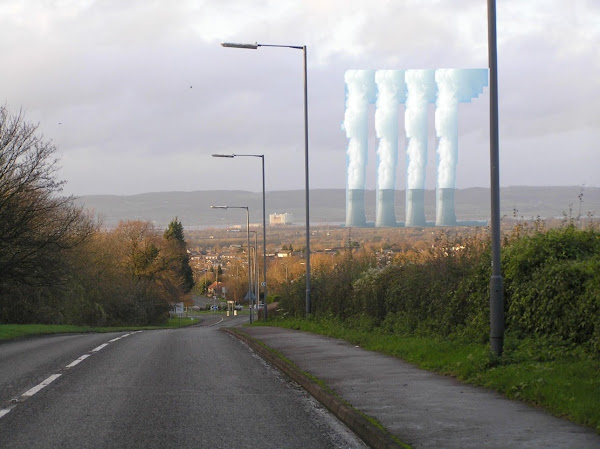
The UK government has set aside money to subsidize nuclear new build. This money is not available for research and development into renewable energy projects, which is why we in Britain have less renewable energy than many other European countries, although we have the best renewable energy resources. The nuclear corporations also put pressure on our government to prevent them introducing proper feed-in tariffs, which would make small scale renewables much more attractive to individual home owners. Germany, which is not going to have any new nuclear power stations, has a policy of paying feed-in tariffs at four times the rate that people pay when they buy electricity. This has resulted in a huge increase in micro-generation projects. You cannot have nuclear power and a proper well-funded renewable energy programme. The two things are not compatible. Angela |
Monday, 28 December 2009
Nuclear New Build is not compatible with a real Renewable Energy Policy


Infant Leukemias near all German Nuclear Power Stations is not an Example of Bad Science
John Mclevy (letters Dec 24) alleges that the German study on infant leukemias near all German power stations is an example of bad science being used for political purposes. However he fails to back this claim with any evidence from the study itself. It is doubtful whether he has read the study.
In fact, the German study is extremely robust: it was commissioned by the German Government and carried out by a expert team of epidemiologists at the University of Mainz. These scientists actually supported nuclear power, so there was no "political purpose" as he falsely alleges. The reality is that the German study is thoroughly competent and its findings are scientifically valid, as vouchsafed by the German Government itself.
Contrary to Mclevy's view, the study is not bad science, but very good science. The problem is that its findings are, in the words of Al Gore, "An Inconvenient Truth" for Mclevy and his pro-nuclear bias.
Faced with this incontrovertible evidence of infant leukemias near nuclear reactors, what should we do? Should we, as the cigarette companies did for decades, seek to distort, deny, and smear the clear evidence of increased cancers, as Mclevy seems to do? Or should we seek safer healthier alternatives to generate electricity?
Mclevy states that he supports nuclear as "we need to stop burning carbon". But does he consider the huge amounts of carbon released during the nuclear fuel cycle, especially by uranium mining, uranium milling, and uranium fuel enrichment?
Renewable energy and energy efficiency measures are a better future for us, not the old-fashioned dangerous WW II technology of nuclear power.
Reg Illingworth
In fact, the German study is extremely robust: it was commissioned by the German Government and carried out by a expert team of epidemiologists at the University of Mainz. These scientists actually supported nuclear power, so there was no "political purpose" as he falsely alleges. The reality is that the German study is thoroughly competent and its findings are scientifically valid, as vouchsafed by the German Government itself.
Contrary to Mclevy's view, the study is not bad science, but very good science. The problem is that its findings are, in the words of Al Gore, "An Inconvenient Truth" for Mclevy and his pro-nuclear bias.
Faced with this incontrovertible evidence of infant leukemias near nuclear reactors, what should we do? Should we, as the cigarette companies did for decades, seek to distort, deny, and smear the clear evidence of increased cancers, as Mclevy seems to do? Or should we seek safer healthier alternatives to generate electricity?
Mclevy states that he supports nuclear as "we need to stop burning carbon". But does he consider the huge amounts of carbon released during the nuclear fuel cycle, especially by uranium mining, uranium milling, and uranium fuel enrichment?
Renewable energy and energy efficiency measures are a better future for us, not the old-fashioned dangerous WW II technology of nuclear power.
Reg Illingworth
Thursday, 24 December 2009
BRISTOL WAS NOT CONSULTED ABOUT THE BUILDING OF A NEW NUCLEAR POWER STATION NEARBY
What kind of a consultation process does not include the city of Bristol, the outskirts of which are a mere eight miles from a proposed new nuclear power station? This is the question that the people of Bristol have been asking, since they discovered that Oldbury has been chosen as the sight for a huge new nuclear power station, eight times bigger than the one that is already there.
Anti-nuclear campaigners have welcomed a move by a Liberal Democrat councillor to commit the city to oppose the building of new atomic power stations near Bristol. Cllr Mark Wright has put forward a motion for the full council meeting on January 19 calling on any consultation for the new plants at Hinkley Point and Oldbury to include people within Bristol.
Bristol 24/7 22nd Dec 2009
http://www.bristol247.com/
http://www.bristol247.com/
Tuesday, 22 December 2009
TOP ENVIRONMENTALISTS PROF TOM BURKE CBE AND GREENPEACE'S BEN AYLIFFE TO SPEAK AGAINST NUCLEAR NEW BUILD
Top environmentalist Professor Tom Burke CBE is giving a boost to Stop Hinkley's campaign to oppose Hinkley C by speaking at a public meeting together with Greenpeace's Ben Ayliffe. Later Jonathon Porritt will also speak in Taunton.
'Nuclear Power: Do we need it?'
Prof Tom Burke CBE & Ben Ayliffe, Head of Greenpeace nuclear team
Town Hall, High Street, Bridgwater
Wednesday 6th January 2010 7.30pm
The meeting is part of a wider campaigning programme including a planned talk by environmentalist Jonathon Porritt (2), leafleting 9,000 homes in the area (3) and a planned protest outside the Electricite de France (EdF) Bridgwater offices (4). Stop Hinkley campaigner Crispin Aubrey also has just returned from the Copenhagen Climate Change conference where he was part of an international group demanding a nuclear-free climate agreement (5).
Tom Burke is a visiting professor at Imperial College, an environmental advisor to international company Rio Tinto and director of Third Generation Environmentalism (E3G) a sustainability policy group. As Special Advisor to three environment ministers in the 1980's and '90's and Director of Friends of the Earth he has been a professional environmentalist for thirty years. He also participated in the Copenhagen Climate Change conference, where he promoted a truly sustainable approach which he defines as excluding nuclear power.
Despite his respected status he was 'disinvited' from speaking at meetings on energy issues at all three major political party conferences in October. The sponsors of the fringes, nuclear company EdF who propose to build Hinkley C, apparently took the draconian step of preventing Professor Burke debate with other experts and our politicians about his non-nuclear approach (6).
In his publication 'Decoding Nuclear Nonsense' last year (7), he showed that the two premises upon which the Government has proposed to build new nuclear power stations are flawed:
"The Government’s case for new nuclear build in Britain rests on two key propositions: that it is essential to maintain Britain’s energy security and that without it Britain cannot meet its climate change emissions. Neither proposition is valid. Nuclear power can do nothing to improve Britain’s energy security or help it meet the urgent challenge of climate change."
Supporting his view he elaborated on these points:
- Even if an order were placed today there would be no new nuclear electricity before 2020.
- The capital cost of nuclear power has tripled in the past three years to $6,000 per Kw.
- The world’s nuclear capacity increased by 2GW in 2007 compared to some 15GW for wind power alone.
- In the next three years, Britain will spend £2.8 billion/year on cleaning up the nuclear legacy of the past and nothing on deploying carbon capture and storage.
Jim Duffy spokesman for Stop Hinkley said: "Tom Burke is a major player in the environmental movement and a thorn in the side of the nuclear industry. It's a boost to our campaign that he and Ben Ayliffe will speak in Bridgwater hopefully convincing many that, despite all the hype, Hinkley C is not necessary for our energy needs or to combat climate change. There is much rage in the local villages against EdF's intrusive plans for expansion. Tom will argue that there is ultimately no case for the disruption."
"The meeting is part of our wider programme which includes another public meeting with well known environmentalist Jonathon Porritt in March, extensive leafleting by volunteers, a delegate at Copenhagen and a protest outside the EdF offices in Bridgwater."
Jim Duffy
Stop Hinkley Coordinator 07798 666756 www.stophinkley.org
Notes:
(1) Description of Prof Tom Burke CBE:
http://www.e3g.org/about/Tom-Burke/
(2) Jonathon Porritt CBE will speak at the Temple Methodist Church, Upper High Street, Taunton, opposite Vivary Park on Tuesday 16th March at 7.30pm.
(3) A copy of the leaflet encouraging residents to write to EdF, objecting to Hinkley C:
http://www.stophinkley.org/EngRevu/SHCQLeaflet.pdf
(4) A protest will be held outside the EdF offices in King Square, Bridgwater on Friday 15th January at 11am. Protestors will wear tape over their mouths to highlight the confined and undemocratic nature of the speeded up planning process aimed at ushering in Hinkley C and other nuclear power stations.
(5) Photograph of Stop Hinkley campaigner Crispin Aubrey at an anti-nuclear protest at the Copenhagen Climate Change conference:
http://www.stophinkley.org/StopPress.htm
(6) The Guardian 1st October 2009:
"And so it was that Tom Burke – a former executive director of Friends of the Earth; special adviser to Michael Heseltine, Michael Howard and John Gummer when they were environment secretaries; and co-founder of Third Generation Environmentalism – found himself in May booked to speak at a series of debates at all three party conferences; and then, last month, found himself unbooked again. The events were sponsored by EDF. The company, having agreed to his appearances, appears to have thought better of the idea. Did it get cold feet? Wouldn't that be something."
http://www.guardian.co.uk/politics/2009/oct/01/edf-iran-nuclear-leppert-rafale
(7) "Decoding Nuclear Nonsense: a reader's guide to the Government's announcement on the future of nuclear power in Britain":
http://www.e3g.org/images/uploads/Decoding_Nuclear_Nonsense_II.pdf
'Nuclear Power: Do we need it?'
Prof Tom Burke CBE & Ben Ayliffe, Head of Greenpeace nuclear team
Town Hall, High Street, Bridgwater
Wednesday 6th January 2010 7.30pm
The meeting is part of a wider campaigning programme including a planned talk by environmentalist Jonathon Porritt (2), leafleting 9,000 homes in the area (3) and a planned protest outside the Electricite de France (EdF) Bridgwater offices (4). Stop Hinkley campaigner Crispin Aubrey also has just returned from the Copenhagen Climate Change conference where he was part of an international group demanding a nuclear-free climate agreement (5).
Tom Burke is a visiting professor at Imperial College, an environmental advisor to international company Rio Tinto and director of Third Generation Environmentalism (E3G) a sustainability policy group. As Special Advisor to three environment ministers in the 1980's and '90's and Director of Friends of the Earth he has been a professional environmentalist for thirty years. He also participated in the Copenhagen Climate Change conference, where he promoted a truly sustainable approach which he defines as excluding nuclear power.
Despite his respected status he was 'disinvited' from speaking at meetings on energy issues at all three major political party conferences in October. The sponsors of the fringes, nuclear company EdF who propose to build Hinkley C, apparently took the draconian step of preventing Professor Burke debate with other experts and our politicians about his non-nuclear approach (6).
In his publication 'Decoding Nuclear Nonsense' last year (7), he showed that the two premises upon which the Government has proposed to build new nuclear power stations are flawed:
"The Government’s case for new nuclear build in Britain rests on two key propositions: that it is essential to maintain Britain’s energy security and that without it Britain cannot meet its climate change emissions. Neither proposition is valid. Nuclear power can do nothing to improve Britain’s energy security or help it meet the urgent challenge of climate change."
Supporting his view he elaborated on these points:
- Even if an order were placed today there would be no new nuclear electricity before 2020.
- The capital cost of nuclear power has tripled in the past three years to $6,000 per Kw.
- The world’s nuclear capacity increased by 2GW in 2007 compared to some 15GW for wind power alone.
- In the next three years, Britain will spend £2.8 billion/year on cleaning up the nuclear legacy of the past and nothing on deploying carbon capture and storage.
Jim Duffy spokesman for Stop Hinkley said: "Tom Burke is a major player in the environmental movement and a thorn in the side of the nuclear industry. It's a boost to our campaign that he and Ben Ayliffe will speak in Bridgwater hopefully convincing many that, despite all the hype, Hinkley C is not necessary for our energy needs or to combat climate change. There is much rage in the local villages against EdF's intrusive plans for expansion. Tom will argue that there is ultimately no case for the disruption."
"The meeting is part of our wider programme which includes another public meeting with well known environmentalist Jonathon Porritt in March, extensive leafleting by volunteers, a delegate at Copenhagen and a protest outside the EdF offices in Bridgwater."
Jim Duffy
Stop Hinkley Coordinator 07798 666756 www.stophinkley.org
Notes:
(1) Description of Prof Tom Burke CBE:
http://www.e3g.org/about/Tom-Burke/
(2) Jonathon Porritt CBE will speak at the Temple Methodist Church, Upper High Street, Taunton, opposite Vivary Park on Tuesday 16th March at 7.30pm.
(3) A copy of the leaflet encouraging residents to write to EdF, objecting to Hinkley C:
http://www.stophinkley.org/EngRevu/SHCQLeaflet.pdf
(4) A protest will be held outside the EdF offices in King Square, Bridgwater on Friday 15th January at 11am. Protestors will wear tape over their mouths to highlight the confined and undemocratic nature of the speeded up planning process aimed at ushering in Hinkley C and other nuclear power stations.
(5) Photograph of Stop Hinkley campaigner Crispin Aubrey at an anti-nuclear protest at the Copenhagen Climate Change conference:
http://www.stophinkley.org/StopPress.htm
(6) The Guardian 1st October 2009:
"And so it was that Tom Burke – a former executive director of Friends of the Earth; special adviser to Michael Heseltine, Michael Howard and John Gummer when they were environment secretaries; and co-founder of Third Generation Environmentalism – found himself in May booked to speak at a series of debates at all three party conferences; and then, last month, found himself unbooked again. The events were sponsored by EDF. The company, having agreed to his appearances, appears to have thought better of the idea. Did it get cold feet? Wouldn't that be something."
http://www.guardian.co.uk/politics/2009/oct/01/edf-iran-nuclear-leppert-rafale
(7) "Decoding Nuclear Nonsense: a reader's guide to the Government's announcement on the future of nuclear power in Britain":
http://www.e3g.org/images/uploads/Decoding_Nuclear_Nonsense_II.pdf
Monday, 21 December 2009
Bristol Lib Dem councillor Mark Wright submits a motion committing Council to opposing nuclear new build
A motion has been submitted for debate by Liberal Democrat councillor Dr Mark Wright (Cabot ward) that notes the many problems that nuclear power presents and that none of the public consultations on the new reactors have come to Bristol even though Oldbury is just 8 miles from the city boundary.
The motion would commit the Council to opposing the building of new reactors, and calls for all future rounds of consultation to come to Bristol so that residents can have their say too.
"Nuclear power is hopelessly uneconomic once you factor in all the costs of decommissioning and radioactive waste disposal. No nuclear power plant has ever been built without considerable public subsidy and guarantee - without those, no company will touch it. If we are going to subside energy then we should develop the vast renewable resources we have here in the South-west instead," said Cllr Wright.
"Diverting our cash and attention to nuclear power will very likely cripple the fledgling renewable power industry. There will be no point in companies investing in developing technologies when multinationals are flooding the energy market with tax-payer subsidised power."
"Then there is the overlap between the technologies of nuclear weapons and nuclear-fission power, which allows countries to hide weapons programs inside civil power programs; the fact that nuclear power stations will arrive too late to fill a possible energy gap; the remaining uncertainties on health and safety issues; the lack of an agreed solution to nuclear waste - the list of problems goes on!"
Alan Pinder of Friends of the Earth said "This is really good news. There is growing anger about the nuclear proposals and the narrowness of the consultations. It is as if they were trying to keep it secret. There should have been exhibitions in Bristol about the proposals. These power stations will affect Bristol, so the City Council and people of Bristol should be closely involved at every stage."
Jim Duffy, Coordinator of Stop Hinkley said: "People from Bristol were very involved in the previous Hinkley C inquiry in 1988-89. It will be an important message if the City Council votes to oppose the new development. Being downwind from Hinkley and so close to Oldbury, Bristolians should not be excluded from deciding on something that could profoundly affect them."
Reg Illingworth of Shepperdine Against Nuclear Energy (SANE) a local group concerned at the development of a new nuclear power plant at Oldbury added, "This motion leads the way for Bristol to be a truly green city showing concern for the earth and its inhabitants."
The motion will be on the agenda at the Council meeting on 19th January.
The motion would commit the Council to opposing the building of new reactors, and calls for all future rounds of consultation to come to Bristol so that residents can have their say too.
"Nuclear power is hopelessly uneconomic once you factor in all the costs of decommissioning and radioactive waste disposal. No nuclear power plant has ever been built without considerable public subsidy and guarantee - without those, no company will touch it. If we are going to subside energy then we should develop the vast renewable resources we have here in the South-west instead," said Cllr Wright.
"Diverting our cash and attention to nuclear power will very likely cripple the fledgling renewable power industry. There will be no point in companies investing in developing technologies when multinationals are flooding the energy market with tax-payer subsidised power."
"Then there is the overlap between the technologies of nuclear weapons and nuclear-fission power, which allows countries to hide weapons programs inside civil power programs; the fact that nuclear power stations will arrive too late to fill a possible energy gap; the remaining uncertainties on health and safety issues; the lack of an agreed solution to nuclear waste - the list of problems goes on!"
Alan Pinder of Friends of the Earth said "This is really good news. There is growing anger about the nuclear proposals and the narrowness of the consultations. It is as if they were trying to keep it secret. There should have been exhibitions in Bristol about the proposals. These power stations will affect Bristol, so the City Council and people of Bristol should be closely involved at every stage."
Jim Duffy, Coordinator of Stop Hinkley said: "People from Bristol were very involved in the previous Hinkley C inquiry in 1988-89. It will be an important message if the City Council votes to oppose the new development. Being downwind from Hinkley and so close to Oldbury, Bristolians should not be excluded from deciding on something that could profoundly affect them."
Reg Illingworth of Shepperdine Against Nuclear Energy (SANE) a local group concerned at the development of a new nuclear power plant at Oldbury added, "This motion leads the way for Bristol to be a truly green city showing concern for the earth and its inhabitants."
The motion will be on the agenda at the Council meeting on 19th January.
THE NUCLEAR DEBATE
Should we be debating whether to build new nuclear power stations or not?
The British Government, who want to push through nuclear new build as fast as possible, introduced something they called the “Justification Process” as part of the “Consultation Process.” What this means is that government advisors are debating the pros and cons of building new nuclear power stations i.e.: whether nuclear generation of electricity can be justified against any possible harm to the health of society.
Ever since the KiKK study produced incontrovertible evidence that childhood leukaemia has increased within a five kilometre radius of ALL German nuclear power stations, there can be no doubt that nuclear power is bad for human health.
How can our government propose that the sacrifice of a few babies and children is “justified” since we will produce so much electricity with nuclear power?
There are some things which are beyond debate. Some points of view that are beneath civilized society.
Of course our British government argues that although there is an increase in childhood leukaemia near to all German nuclear power stations, this just might be a coincidence, or it might be caused by “population mixing” i.e. by workers coming into these areas bringing viruses that cause cancer. No such viruses have ever been found and the German scientists who produced the KiKK study did not even consider the population mixing theory. Frankly they thought it was laughable.
Should we, the general public, even be entering into the consultation process, that is if we are aware that such a process is happening? Or should we be protesting as loudly as we can against this demon technology, that is harmful to human health, produces radioactive waste that will remain radioactive for thousands of years and that we do not know what to do with, that poses a terrorist threat, that is hugely expensive to build and relies on a fuel that will be exhausted within our lifetimes?
No, I say. No debate. Protest and Survive.
The British Government, who want to push through nuclear new build as fast as possible, introduced something they called the “Justification Process” as part of the “Consultation Process.” What this means is that government advisors are debating the pros and cons of building new nuclear power stations i.e.: whether nuclear generation of electricity can be justified against any possible harm to the health of society.
Ever since the KiKK study produced incontrovertible evidence that childhood leukaemia has increased within a five kilometre radius of ALL German nuclear power stations, there can be no doubt that nuclear power is bad for human health.
How can our government propose that the sacrifice of a few babies and children is “justified” since we will produce so much electricity with nuclear power?
There are some things which are beyond debate. Some points of view that are beneath civilized society.
Of course our British government argues that although there is an increase in childhood leukaemia near to all German nuclear power stations, this just might be a coincidence, or it might be caused by “population mixing” i.e. by workers coming into these areas bringing viruses that cause cancer. No such viruses have ever been found and the German scientists who produced the KiKK study did not even consider the population mixing theory. Frankly they thought it was laughable.
Should we, the general public, even be entering into the consultation process, that is if we are aware that such a process is happening? Or should we be protesting as loudly as we can against this demon technology, that is harmful to human health, produces radioactive waste that will remain radioactive for thousands of years and that we do not know what to do with, that poses a terrorist threat, that is hugely expensive to build and relies on a fuel that will be exhausted within our lifetimes?
No, I say. No debate. Protest and Survive.
Saturday, 19 December 2009
The New Nuclear Reactor being built at Okiluoto may not be safe

Finnish nuclear watchdog STUK has ordered welding of the reactor cooling system to a halt at Olkiluoto 3 construction site, Finland. A welder had failed to consult or comply with welding specifications and consequently too high electric current was used in welding. Substandard practice had passed three layers of inspections: subcontractor, French Areva and Finnish investor TVO. The experiences from Olkiluoto show that as far as nuclear is concerned, safety and economics don’t mix.
"Greenpeace exposed already a year ago, that welding without required tests and paperwork was a common practice in welding of Olkiluoto 3 containment building. STUK failed to crack down on rampant violations at the time, claiming that quality of welds was sufficient at the time. Greenpeace warned already back then that neglect of quality requirements would affect even more critical phases of work," Greenpeace energy campaigner Lauri Myllyvirta reminds.
The cooling system is the most central and vulnerable part of a nuclear reactor, because its failure can lead to a full-scale nuclear accident. Components of the cooling system are not replaced during the entire lifetime of the reactor. There have also been problems with other parts of the cooling system. During welding of the largest pipes of the system, the ones connected directly to the reactor core, cracks were observed aroubd the weld seams. The cause can be either defective material or unsuitable welding method.
"The unrealistic price and timetable of Olkiluoto 3 project are leading to more and more violations of quality requirements. The combined impacts of all the problems is impossible to assess when there are severe flaws in both the design and the construction of the reactor. Proposed new reactor projects are based on equally unrealistic assumptions, so the problems would be bound to reoccur," Myllyvirta said.
Contact: Lauri Myllyvirta, energy campaigner: +358 50 3625 981
This is the type of reactor that Horizon want to build at Shepperdine. If they can't get it right in Finland, what hope do we have that they will get it right in Britain?
http://www.olkiluoto.info/en/15.10.2009 Lauri Myllyvirta
Subscribe to:
Posts (Atom)
